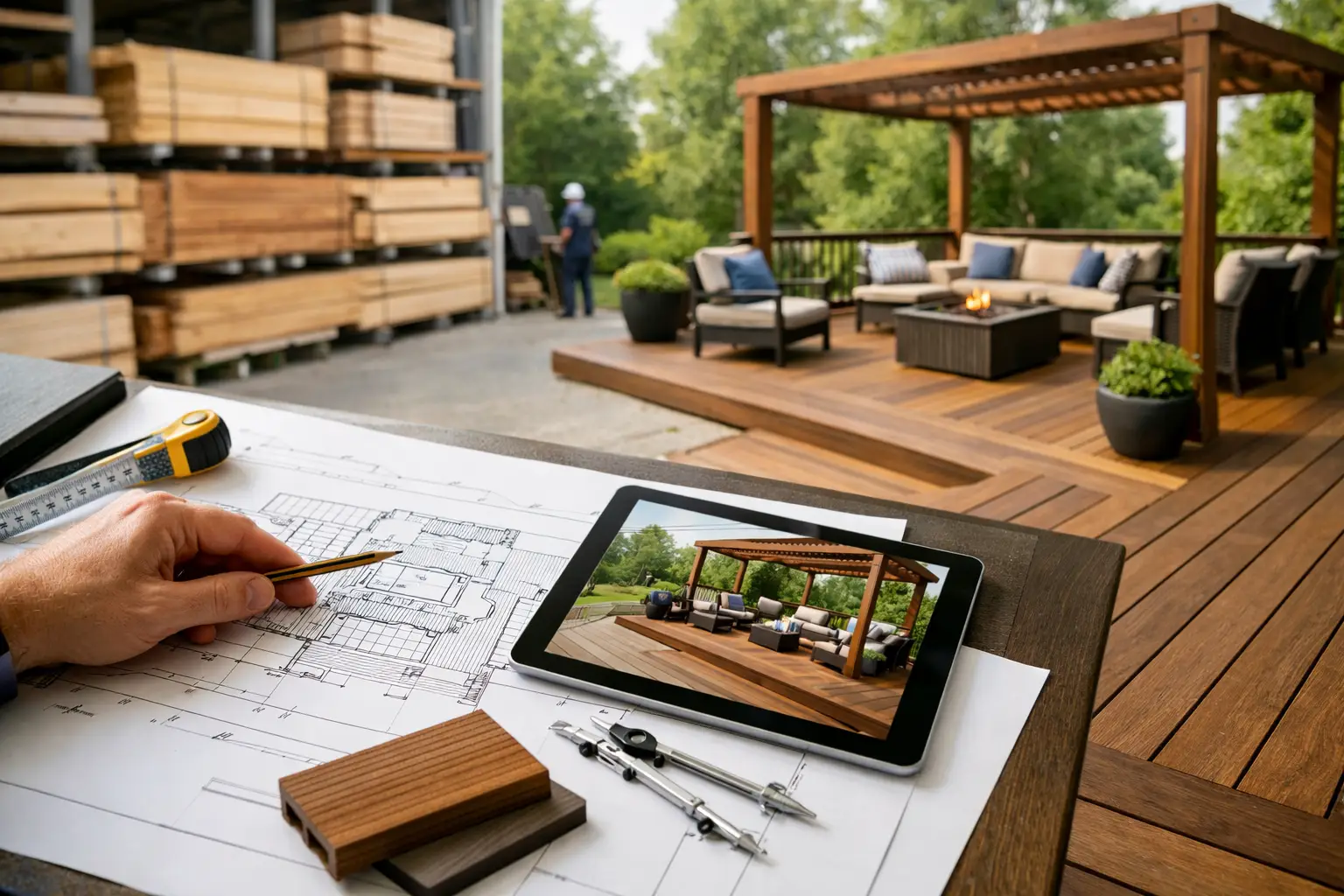
A contractor walks in with a sketch, a site address, and a homeowner who wants a deck before summer. If your team can only quote boards and hardware after someone else produces a plan, the sale is already exposed. When you add deck design to lumber dealer services, you move from supplying materials to controlling a more valuable part of the customer’s decision.
That shift can increase package sales, protect margin, and make your yard harder to replace. It can also create a new operational bottleneck if the work is handed to estimators who are already buried in takeoffs, counter traffic, and builder revisions. The opportunity is real, but the delivery model has to be built for production.
Why Lumber Dealers Are Well Positioned to Sell Deck Design
A deck project rarely starts with a complete material list. It starts with uncertainty: layout, elevation changes, stairs, railing choices, code considerations, footing locations, framing direction, and a budget that may change three times before the homeowner approves anything. Contractors need a fast path from concept to an order they can confidently install.
Lumber dealers already sit close to the transaction. You know local contractor preferences, product availability, lead times, and the practical consequences of substituting one decking line, fastener system, or railing package for another. A standalone designer may create an attractive plan, but a dealer-supported design service can connect the drawing to real materials and a buildable package.
That connection matters commercially. A design package creates a reason for the contractor to keep the entire project with your yard instead of pricing decking in one place, framing in another, and railing somewhere else. It also gives your sales team a clearer basis for presenting upgrades. Composite decking, picture framing, concealed fastening, lighting, drainage, fascia, and premium railing are easier to sell when they appear in a visual, organized proposal rather than as scattered line items.
The goal is not to turn every lumber dealer into an architecture firm. The goal is to remove the friction between a customer’s idea and a complete, profitable material order.
Add Deck Design to Lumber Dealer Services Without Slowing Sales
The first decision is defining what your deck design service will and will not do. A simple service may include a customer-facing layout, framing concept, material takeoff, and product presentation. A more advanced offer can include permit-ready drawing sets where local requirements, project scope, and qualified review processes allow.
Those are different production tiers, and they should not be priced, promised, or staffed the same way. A basic backyard platform with standard stairs is not the same as a multilevel deck attached to a complex home, with elevated framing, custom cable railing, drainage, and a permit timeline. Treating both projects as quick counter work is how quote speed disappears.
A strong operating model begins with a clean intake process. Salespeople need to gather the information designers actually require: photos, rough dimensions, lot and grade conditions, house attachment details, desired product line, stair location, railing preference, and the project’s intended use. Missing information does not vanish once the order reaches design. It comes back as emails, phone calls, and delays.
Set expectations early as well. Tell contractors what they receive, what they must verify in the field, and when engineering or local code review may be required. A deck plan can support selling and installation, but it should not be represented as a substitute for professional engineering when the project conditions require it.
Build a Repeatable Design-to-Quote Workflow
The most profitable services are not dependent on one talented employee remembering every step. They run through a visible workflow with checkpoints.
Start by classifying incoming jobs by complexity and turnaround expectation. Standard projects can move through a defined design queue. Projects with structural uncertainty, unusual geometry, or incomplete site information should be flagged immediately rather than consuming hours of unplanned revision work.
Next, connect the design output to estimating. The drawing should support a material list that is organized around how your yard quotes and fulfills an order. That means aligning product naming, unit conventions, waste assumptions, package components, and approved alternates. A beautiful rendering that does not translate into an accurate bill of materials is a marketing asset, not a production tool.
Finally, establish a revision policy. Contractors expect changes, especially when homeowners see a layout for the first time. That is normal. Unlimited revisions with no intake discipline are not. Define what is included, document approvals, and charge or reset timelines when the scope changes materially.
The Margin Case Is Bigger Than a Design Fee
Some dealers hesitate because they assume deck design must pay for itself through a standalone fee. A fee can be useful because it filters out low-intent requests and assigns value to technical work. But the larger return often comes from increased capture of the material package.
A well-designed deck quote can improve close rates because customers understand what they are buying. It can raise average order value by making upgrades visible. It can reduce material omissions that become jobsite emergencies. And it can give contractors a reason to bring projects to your sales team earlier, before a competitor has locked in the specification.
There is a trade-off. If the service is free for every walk-in customer, demand can overwhelm capacity and turn skilled production time into unpaid prospecting. If the fee is too high or the process feels slow, contractors may continue doing rough layouts themselves. Many dealers solve this by applying a design fee toward the material purchase, offering different service levels, or reserving expedited turnaround for established accounts.
The right model depends on your contractor mix, local competition, average package value, and design capacity. What does not depend on market conditions is the need to measure the service as a revenue engine. Track design requests, turnaround time, conversion to material orders, average package value, revision volume, and gross margin by project type. Those numbers reveal whether the service is producing growth or simply moving workload around.
Capacity Is the Real Constraint
Most lumber dealers do not fail at deck design because demand is weak. They fail because the same people expected to sell, estimate, coordinate deliveries, and solve customer issues are also expected to produce detailed plans. During peak season, design becomes the work that gets pushed to tomorrow.
Hiring locally can help, but experienced deck designers, estimators, and CAD production professionals are difficult to recruit and expensive to hold through uneven demand. Training a new employee also takes time, especially when they need to understand decking systems, framing practices, local market expectations, and your internal quoting standards.
A dedicated technical production team changes the equation. Rather than forcing sales staff to become full-time designers, dealers can route qualified requests to trained designers who work from established templates, product libraries, and review rules. The dealer retains customer ownership, pricing control, and local market judgment. The production team provides the focused capacity required to keep quotes moving.
This is where a specialized partner such as All Points Technical can support scale. Dedicated offshore and onshore technical teams can produce architectural deck designs, material takeoffs, CAD work, and related estimating support while your local team stays focused on contractors, pricing, and fulfillment. The advantage is not simply lower labor cost. It is the ability to add skilled output without waiting months to recruit, onboard, and stabilize a new internal department.
What Quality Control Must Cover
Speed only creates value when the output is dependable. Before launching a design service, build a review standard that covers the issues most likely to affect order accuracy and customer confidence.
Your quality process should verify that dimensions are consistent, stairs and railings are accounted for, framing assumptions are visible, product selections match the quote, and the takeoff reflects the plan. It should also identify items that need field verification or additional review. The exact checklist will vary by product category and jurisdiction, but the discipline should be consistent.
Software matters, but it is not the whole answer. Design platforms, CAD tools, estimating systems, and product configurators can accelerate production. They do not replace trained people who understand how a deck is assembled, where a plan creates installation risk, or why a material list may look correct while still missing a critical accessory.
Begin with a controlled rollout. Select a manageable group of contractor accounts, define turnaround targets, and test the handoff from intake through final order. Review the first projects closely. The patterns will show up fast: incomplete requests, recurring revisions, unclear pricing rules, or product data that needs to be standardized.
A dealer that can turn a rough deck idea into a clear plan, accurate package, and timely order becomes more than a pickup location for lumber. It becomes part of the contractor’s production system – and that is a position competitors cannot win with a lower board price alone.
Leave a Reply