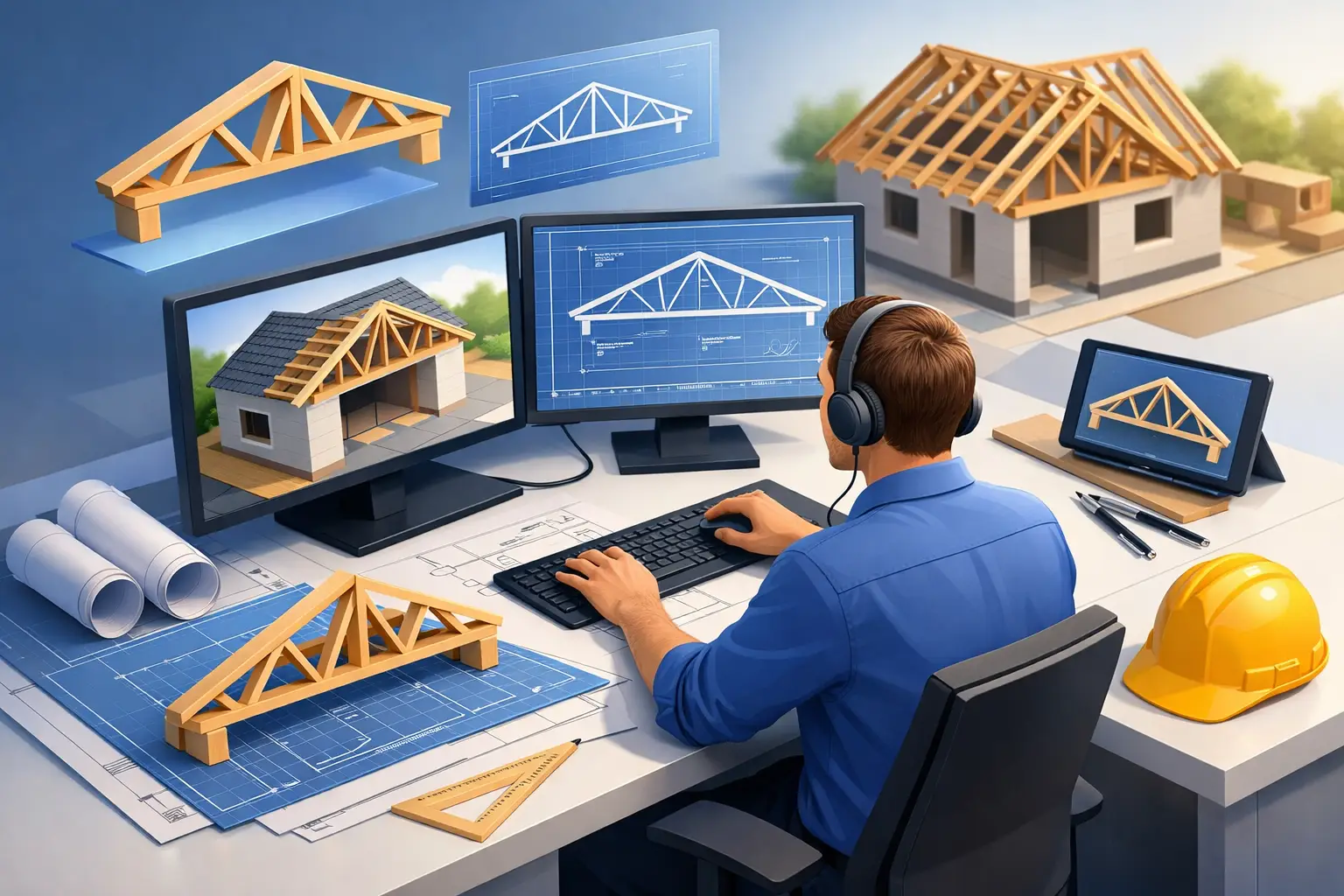
A delayed truss package can stall framing, disrupt delivery schedules, and eat margin fast. That is why the question what is a truss designer matters more than it sounds. In real-world construction operations, a truss designer is not just a drafter pushing lines on a screen. This role sits at the intersection of engineering intent, manufacturing reality, code compliance, and production speed.
What Is a Truss Designer in Practical Terms?
A truss designer creates the technical layouts and design documents used to manufacture structural trusses for roofs and floors. Those trusses are typically built from wood components connected with metal plates, and they must perform under specific loading conditions, span requirements, and jobsite constraints.
In practice, the truss designer takes architectural plans, engineering criteria, and project specifications, then turns that information into production-ready truss designs. The work usually includes truss placement layouts, individual truss profiles, loading inputs, connector plate selection, bearing checks, web configurations, and manufacturing documentation.
That sounds straightforward until volume hits. On a busy pipeline, the truss designer is often managing changing plans, conflicting dimensions, rushed bid deadlines, revised loads, municipal requirements, and plant-specific production rules at the same time. Good designers keep the package moving without sacrificing accuracy. Great ones protect your schedule and your margin.
What a Truss Designer Actually Does Every Day
The job is part technical design, part coordination, and part problem-solving under pressure. A truss designer reviews incoming plans to determine roof geometry, spans, pitches, overhangs, girder requirements, and loading criteria. They then build the truss system in specialized software, validate the structural configuration, and produce the output needed for manufacturing and approval.
A large part of the role is interpreting incomplete information. Plans are not always clean. Dimensions conflict. Framing intent is sometimes implied instead of stated. Mechanical openings may affect webs. Energy heels may change profiles. A designer has to catch those issues early, flag them, and keep the job advancing.
They also coordinate with estimators, sales teams, project managers, plant production staff, and in many cases engineers of record or building designers. If the package works structurally but creates manufacturing headaches, it is not a strong design. If it works in the plant but misses field conditions, it creates callbacks and delays. The best truss designers understand both sides.
Where Truss Design Fits in the Construction Process
Truss design usually happens after the basic building plans are developed but before fabrication begins. For builders, component manufacturers, and lumber dealers, this phase is critical because it directly affects quoting accuracy, shop scheduling, material usage, and field installation.
If design capacity is weak, the entire operation feels it. Sales cannot turn bids fast enough. Manufacturing gets compressed schedules. Install crews deal with preventable issues. Management ends up paying for the same bottleneck twice – once in labor inefficiency and again in lost opportunity.
That is one reason this role has become so valuable. A capable truss designer does not only create drawings. They help a business increase bid velocity and maintain production continuity.
What Software Does a Truss Designer Use?
Most truss designers work in specialized component design software rather than general drafting programs alone. The exact platform depends on the manufacturer, plate supplier, and workflow, but the role typically involves software built for truss analysis, plate design, loading, and manufacturing output.
These systems allow the designer to model trusses, apply loading conditions, evaluate structural performance, and generate cut sheets and shop documentation. Some roles also involve CAD, BIM coordination, or integration with broader production workflows, especially on larger or more complex projects.
Software skill matters, but it is not the whole story. A fast software user without framing judgment can create expensive problems quickly. On the other hand, a designer with strong construction logic and plant awareness often brings more long-term value than someone who only knows which buttons to click.
Is a Truss Designer an Engineer?
Usually, no. That distinction matters.
A truss designer is typically responsible for preparing the truss design package within the parameters of building codes, engineering standards, software calculations, and project criteria. Depending on jurisdiction, company structure, and project type, a licensed engineer may review or seal portions of the design, especially when delegated design responsibilities apply.
So the truss designer is not always the final legal authority, but the role is still highly technical. It requires a working knowledge of structural behavior, load paths, bearing conditions, uplift, deflection, bracing concepts, and material limitations.
This is where many outsiders underestimate the position. They hear “designer” and think decoration or drafting support. In this space, the work is production-critical and structurally sensitive. Mistakes show up in wasted lumber, field failures, rejected submittals, and delayed jobs.
The Skills That Separate Average from Elite
If you are hiring or scaling a truss operation, you are not just looking for someone who can complete a layout. You are looking for someone who can perform under operating pressure.
A strong truss designer understands roof and floor systems, reads plans quickly, and catches ambiguity before it becomes rework. They know how to balance code requirements, engineering logic, software output, and manufacturing efficiency. They communicate clearly with internal teams and do not freeze when the revision set lands at 4:30 p.m.
The elite tier goes further. They reduce back-and-forth, design with plant realities in mind, and support estimating and sales by turning work faster. They understand that every delayed design package affects downstream capacity. That commercial awareness is what makes the role so valuable.
Why Truss Designers Are Hard to Find
This is a niche discipline inside a niche discipline. You need people who understand construction documents, structural behavior, truss software, and component manufacturing. Then you need them to work accurately at speed.
That talent pool is not deep in many US markets. Companies often compete for the same limited group of experienced designers, and training new people takes time. Even when businesses find candidates, they still face onboarding delays, retention risk, and fluctuating demand across seasons and project cycles.
That is why more component manufacturers, dealers, and construction firms are rethinking how they build design capacity. Instead of relying only on local hiring, they are using specialized staffing and production partners to add trained truss design support faster and more cost-effectively. For companies trying to scale output without waiting months to recruit, that model can be a major operational advantage.
What Is a Truss Designer Worth to the Business?
The answer depends on your workflow, but the impact is usually larger than the org chart suggests.
A productive truss designer helps shorten turnaround time, improve quote responsiveness, reduce rework, support manufacturing flow, and keep projects moving. If your sales team can bid more work because design support is available, that affects revenue. If your production team receives cleaner packages, that affects labor efficiency. If your business can maintain output across time zones, that affects cycle time.
This is why the role should be viewed as a growth function, not just a support function. In a tight labor market, truss design capacity can become the difference between controlled scaling and constant bottlenecks.
When You Need One Truss Designer Versus a Team
Not every business needs a large internal bench. A smaller operation with predictable volume may do well with one or two experienced designers and occasional overflow support. A higher-volume manufacturer or dealer handling multiple branches, seasonal surges, or aggressive sales targets may need a more flexible structure.
That is where team-based models make sense. Instead of tying growth to local recruiting alone, businesses can add dedicated design capacity that expands or contracts with the pipeline. All Points Technical built its model around exactly that problem – helping construction-related businesses get technical teams up and running in days, not months.
The right solution depends on your job mix, software environment, revision volume, and internal review process. There is no one-size-fits-all answer. But waiting until design becomes the bottleneck is usually the expensive option.
What to Look for If You Are Hiring Truss Design Support
Experience matters, but relevance matters more. A candidate who has worked in the same software, product category, and market conditions as your business will ramp faster than someone with a broad but less applicable background.
You also want to evaluate output quality, communication, and responsiveness. Can they interpret imperfect plan sets? Do they understand manufacturing constraints? Can they handle revision pressure without losing accuracy? Trial work is often the fastest way to separate real capability from a polished resume.
For operations leaders, the real question is not just what is a truss designer. It is whether your current design capacity is strong enough to support the business you want next quarter, not just the business you have today. If the answer is no, the smartest move is to fix the capacity gap before it starts costing you work.
Leave a Reply