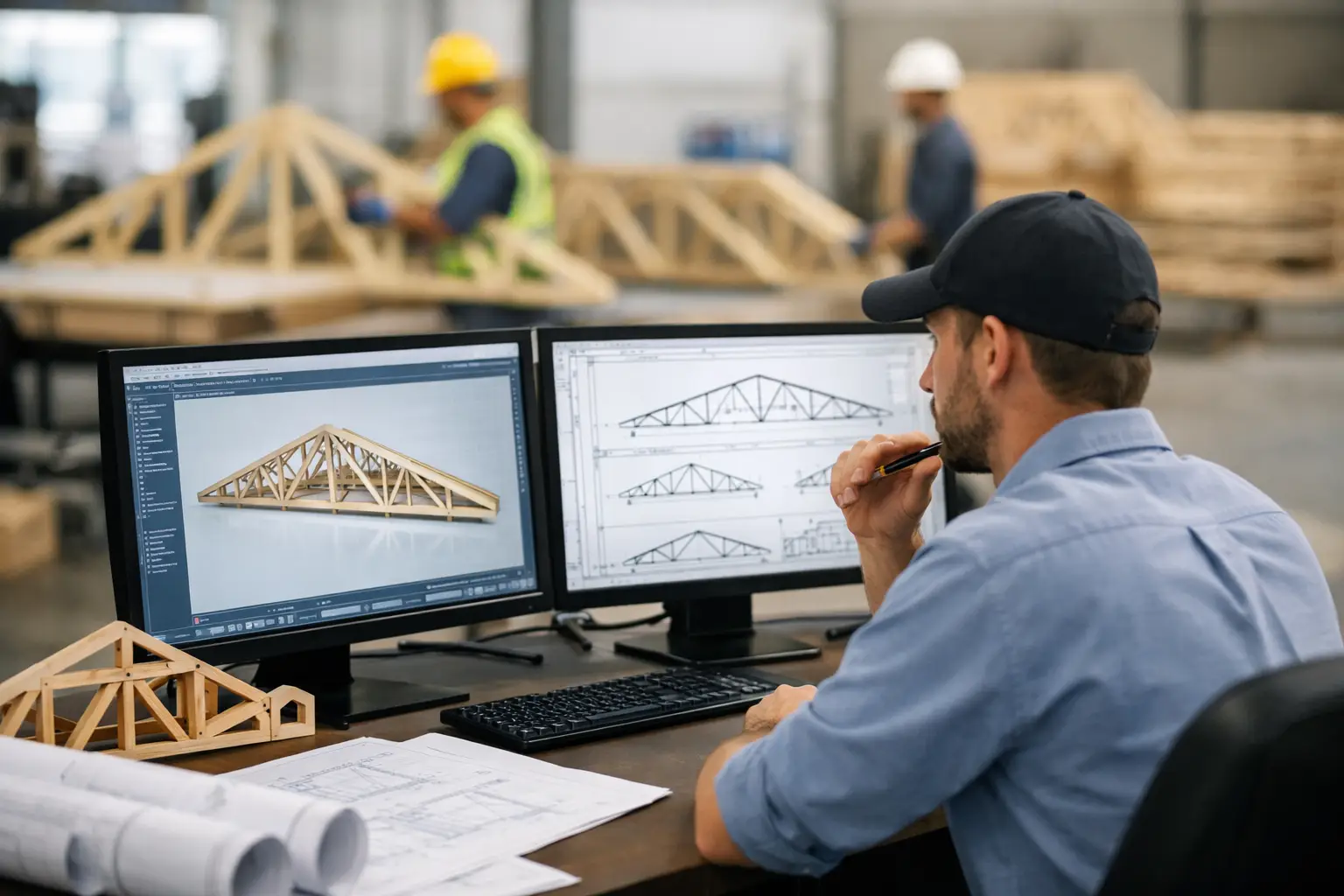
A truss plant can have orders in hand, experienced production crews ready to build, and customers demanding shorter lead times – then lose momentum because two open design seats stay vacant for months. That is the practical answer to why are truss designers hard to hire: the role sits at the intersection of structural knowledge, manufacturing reality, software skill, and speed. Few candidates can perform all four at the level a busy operation requires.
This is not a standard CAD hiring problem. A truss designer affects quote turnaround, material usage, production flow, engineering coordination, delivery dates, and margin. When design capacity falls behind, the entire plant feels it.
Why Are Truss Designers Hard to Hire in the First Place?
The talent pool is small because truss design is a specialized trade learned through hands-on exposure, not a job most graduates enter directly. A capable designer must understand roof and floor truss systems, loading concepts, plates, lumber grades, bearing conditions, heel details, bracing requirements, and constructability. They also need to produce work accurately in specialized platforms such as MiTek, Alpine, Simpson, or comparable component design software.
That combination takes time to build. A person can be proficient in general CAD and still need substantial training before they can release truss packages that work for a specific plant, its machinery, its material inventory, and its customers. A person can understand residential framing and still struggle with design software, multi-family complexity, or the pace of a high-volume component operation.
The strongest designers are rarely on the open market. They are usually employed, productive, and well aware that their skill is in demand. Plants are not competing only with neighboring component manufacturers. They are competing with lumber dealers, builders, EWP suppliers, engineering-adjacent firms, and remote employers that can offer flexibility without asking the designer to relocate.
The Job Has Become More Demanding
The phrase “truss designer” can make the work sound narrow. In reality, many plants need one person to manage much more than layout and individual truss profiles. Designers may interpret incomplete plans, identify conflicts before production, communicate revisions to sales teams, coordinate with engineers, resolve field questions, and help protect production from avoidable waste.
Modern construction has also increased the technical burden. Homes are more complex. Rooflines are less forgiving. Multi-family and light commercial projects involve tighter coordination. Builders expect faster revisions, while permitting and engineering requirements leave less room for assumptions.
A designer who can turn drawings into a manufacturable package quickly is valuable because they prevent expensive handoffs. They do not simply model what is on the plan. They recognize what will fail in the field, what will confuse the shop, and what needs clarification before material is cut.
That is why hiring based on software keywords alone often fails. A candidate may know the interface but lack the judgment that separates a drafter from a dependable component designer.
Training Takes Longer Than Most Hiring Plans Allow
Many operations respond to a vacancy by hiring an entry-level candidate and planning to train them internally. That can be a sound long-term move, but it does not solve an immediate capacity gap.
Training requires time from the exact people who are already overloaded: senior designers, design managers, engineering contacts, and production leaders. During peak demand, those leaders need to keep orders moving. Pulling them into daily training can slow the team further.
The risk is not just ramp time. Truss design errors carry real operational consequences. An incorrect bearing, missed loading condition, unbuildable profile, or unclear output can trigger rework, delayed deliveries, damaged customer confidence, and margin erosion. Plants cannot responsibly rush a trainee into complex work simply because the backlog is growing.
This creates a difficult cycle. The business needs experienced capacity to create room for training, but it cannot create that room because experienced capacity is already scarce.
Geography Limits an Already Tight Candidate Pool
Many truss plants operate outside major metro areas, where proximity to timber supply, delivery routes, and local building demand makes business sense. Those locations can be ideal for manufacturing but challenging for specialized recruiting.
A strong truss designer may not live within commuting distance. Relocation is expensive, disruptive, and increasingly difficult to sell when remote or hybrid technical roles are available elsewhere. Even where remote design is feasible, some companies have not established the workflows, communication standards, quality checks, and data controls needed to manage it confidently.
The result is a false choice: wait for a local candidate who may never appear, or accept a hire who needs more training than the operation can absorb. Neither option supports aggressive growth.
The Real Cost Is Lost Throughput, Not Just an Empty Seat
An open truss designer role is often treated as an HR issue. It is an operations and revenue issue.
When estimating and design queues grow, sales teams hesitate to pursue additional work because they cannot promise turnaround. Builders receive quotes later than competitors. Revision cycles stretch out. Existing designers work overtime, increasing burnout and the chance that another key person leaves.
The financial impact depends on the plant, but the pattern is consistent: constrained design capacity limits bid capacity, and limited bid capacity restricts growth. A plant may have production availability and market demand yet still be unable to convert opportunity into revenue because technical work is bottlenecked upstream.
Hiring slowly also creates hidden costs. Recruiter fees, manager interview time, relocation incentives, signing bonuses, and extended vacancies can add up quickly. Then there is the opportunity cost of work declined or delayed while the search continues.
Why Traditional Recruiting Often Misses the Mark
Generic recruiting channels are built for roles with broad candidate pools. Truss design is different. Job titles vary widely, software experience is fragmented, and resumes do not always reveal whether someone can produce accurate, plant-ready work under pressure.
A candidate might call themselves a structural designer but have experience limited to drafting. Another might have truss software experience but only on straightforward residential projects. A third may be technically capable but unfamiliar with the communication rhythm, release standards, or material constraints that matter to your operation.
The hiring process needs technical screening, practical validation, and a clear definition of what the seat must accomplish. Is the immediate need estimating support, production design, floor systems, multifamily work, engineering coordination, or overflow coverage? The answer changes the profile of the right hire.
Build Capacity Instead of Waiting for the Perfect Local Hire
For many plants, the strongest answer is not abandoning domestic hiring. It is separating long-term talent development from immediate production needs.
Keep building internal bench strength. Promote capable team members. Create a training path that makes sense for your operation. But do not make growth dependent on the timeline of one local search.
A dedicated technical delivery team can provide experienced truss design capacity while the plant retains control over standards, priorities, and customer commitments. The model works best when it starts with defined work, clear inputs, documented quality expectations, and trial assignments that validate both technical ability and communication.
Once the workflow is proven, capacity can expand with demand. That matters during seasonal surges, major builder programs, staff leave, acquisitions, or periods when the sales pipeline outpaces internal design bandwidth. With teams working across time zones, work can also progress outside the plant’s standard office hours – provided review and handoff processes are disciplined.
All Points Technical was built around this exact production challenge: helping construction businesses add specialized technical capacity without waiting months for conventional hiring to catch up.
What Good Truss Design Capacity Looks Like
The goal is not simply to fill a seat. It is to create output that reduces friction across the operation. A productive designer or delivery team should be able to work from established standards, ask the right questions early, maintain revision control, and release packages that production can trust.
That requires a practical onboarding process. Start with a representative sample of your work, not an artificially simple test. Establish design assumptions, preferred details, software access, communication channels, checking procedures, and escalation paths. Measure turnaround, accuracy, rework, and the amount of management attention required.
There is a trade-off. External capacity is not a substitute for poor internal process. If plans arrive incomplete, standards are undocumented, or revisions are handled informally, any team will struggle. But a well-run plant with a defined workflow can gain meaningful flexibility without carrying the full cost and risk of every hire on its payroll.
The truss designer shortage is not likely to disappear because a job posting has been refreshed. Plants that protect margins and keep bidding aggressively will treat design capacity as a strategic production asset – one that can be built, tested, and scaled before the backlog starts making decisions for them.
Leave a Reply