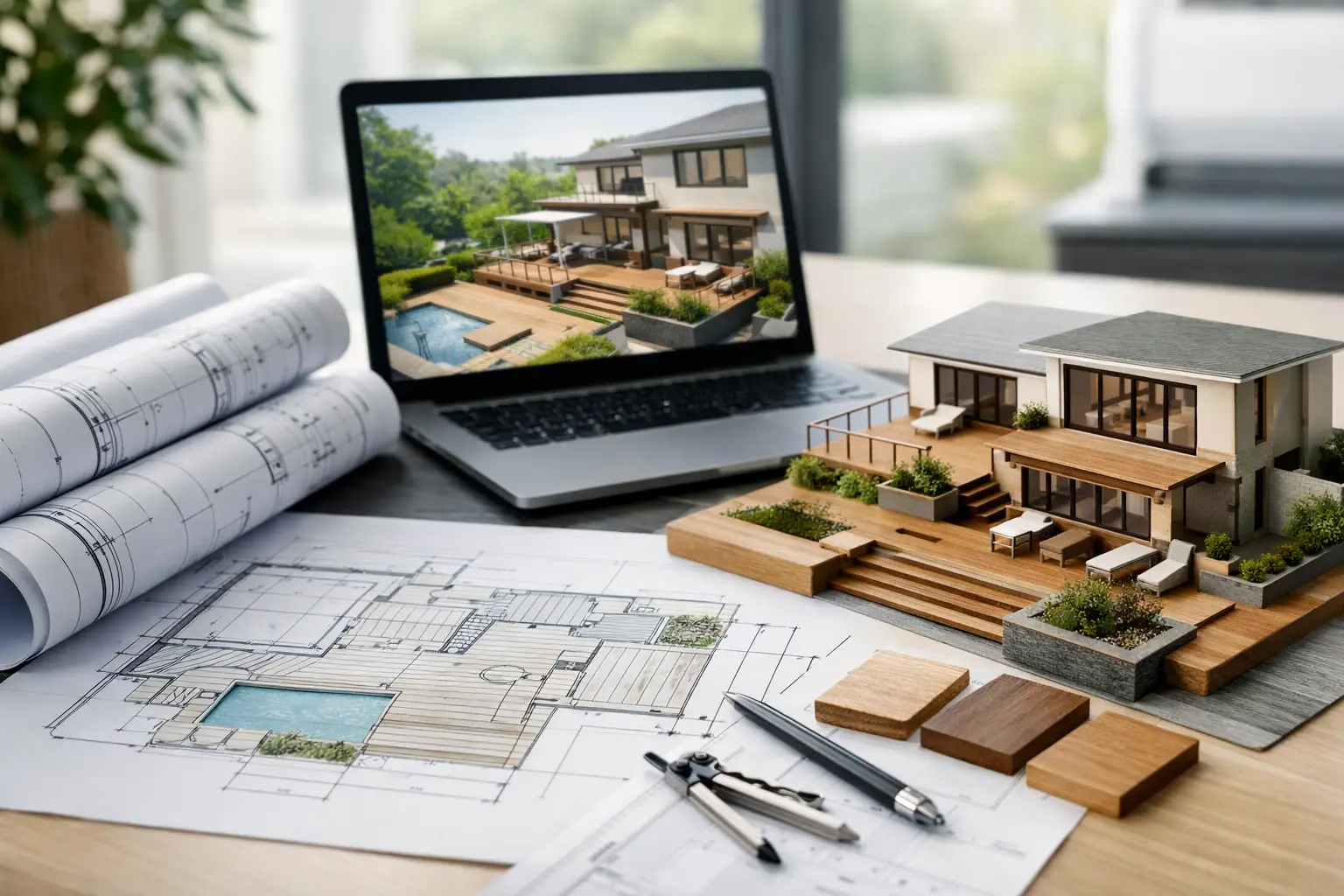
A deck package should not be the reason a permit stalls, a bid slips, or a project manager starts chasing revisions at 6:30 p.m. Yet that is exactly what happens when architectural deck design services are treated like overflow drafting instead of a production function tied directly to schedule, margin, and client confidence.
For builders, dealers, and design-driven construction teams, deck work sits in an awkward space. It looks straightforward until it is not. One job needs a clean permit set for a simple rear addition. The next includes multi-level geometry, custom stairs, roof transitions, drainage considerations, railing coordination, and code-driven details that vary by jurisdiction. The workload spikes fast. Internal teams get stretched. Turn times suffer. The sales side feels it first.
Why architectural deck design services matter more than most teams expect
Most companies do not lose money on deck design because one drawing is expensive. They lose money because inconsistent production slows everything around it. Estimating waits on usable documents. Sales cannot move from concept to quote with confidence. Operations inherits avoidable RFIs. Field crews spend time interpreting intent instead of building.
Good architectural deck design services fix that by turning deck design into a repeatable, scalable workflow. That means design output is not dependent on whichever in-house person happens to have time this week. It means details are produced with the same logic every time, software standards stay intact, and review cycles become manageable instead of chaotic.
That matters most when demand is uneven. Many construction businesses do not need another full-time local hire for deck design year-round. They need dependable capacity when jobs stack up, and they need it without carrying overhead during slower periods. That is where a specialized production partner changes the economics.
What strong deck design services actually include
Architectural deck design services should do more than put lines on a page. If the output is going to support permits, client approvals, coordination, and downstream production, the scope has to be practical.
At a minimum, the service should cover plan development, elevations, section details, framing layouts, stair and railing coordination, and document organization that fits how your team builds and reviews. Depending on the project, it may also include concept support, redraws from marked-up plans, revisions for municipal comments, and drafting aligned to internal standards.
The right level of service depends on your business model. A lumber dealer supporting multiple outside builders may need fast-turn permit-ready packages with disciplined formatting and repeatable details. A design-build contractor may need more front-end collaboration to move a customer from idea to signed job. A manufacturer or structural-focused team may need deck plans that coordinate tightly with truss, component, or broader framing workflows.
That is the key distinction. Architectural deck design services are valuable when they fit the way your operation actually sells and builds. A beautiful drawing that does not support your process is still a production problem.
Where bottlenecks usually show up
Most deck design bottlenecks are not caused by lack of effort. They come from three predictable pressure points.
The first is fragmented ownership. Sales gathers rough inputs, someone in design interprets them, another person cleans up the file, and a manager reviews it late because higher-priority work got in the way. Every handoff introduces delay and inconsistency.
The second is hiring friction. Skilled technical production talent is hard to find, harder to train, and expensive to keep underutilized. If your deck volume rises and falls with seasonality or market demand, building a local bench for every specialty can hurt margins as much as understaffing hurts throughput.
The third is software and standards inconsistency. Even experienced drafters can create headaches if file setup, layer use, annotation logic, and construction detailing vary from one job to the next. Review time expands because managers are correcting production habits, not evaluating design intent.
These are operational issues, not creative ones. That is why the fix is usually not “find a better drafter.” The fix is a delivery model built for volume, standards, and speed.
When outsourcing deck design makes business sense
Not every company should outsource every deck package. If your in-house team has stable capacity, low turnover, and enough specialized bench strength to absorb peaks, keeping production internal may be the right move.
But that is not the reality for many growing construction businesses. If your backlog is healthy, bid demand is rising, and technical recruiting keeps slowing expansion, outsourced architectural deck design services can be the faster path.
The strongest use cases are clear. You need to increase bid capacity without waiting months to hire. You need overnight or extended-hour production support. You need to protect internal senior staff from getting buried in routine drafting. Or you need a trialable way to add capacity before committing to permanent headcount.
This is also where trade-offs matter. Outsourcing works best when the partner understands construction production, not just drafting software. A low-cost drafting vendor may generate files, but if they do not understand buildability, code-sensitive details, revision flow, or discipline-specific expectations, you may save on hourly rate and lose on rework.
What to look for in an architectural deck design partner
The first requirement is specialization. Deck design is adjacent to broader architectural drafting, but it is not identical. You want a team that understands framing logic, stair geometry, structural coordination, and the practical needs of permit and construction documents.
The second is onboarding speed. If a provider needs months to understand your templates, standards, and review process, they are not solving your capacity problem. The right partner gets productive quickly, proves quality through real work, and scales with demand.
The third is operational flexibility. Some weeks you need two projects turned fast. Other weeks you need a steady pipeline. Your provider should be able to support both without forcing a rigid staffing model that does not match your workload.
The fourth is quality control. Ask how work is checked, how revisions are tracked, who owns standards compliance, and how communication flows when comments come back. Strong production teams do not rely on heroics. They run on process.
This is where an industry-specific partner stands apart. All Points Technical built its model around technical construction production, not generic outsourcing. That difference matters when the goal is to increase output without creating another layer of management burden.
How architectural deck design services improve margin and bid velocity
Most buyers initially think about labor savings. That matters, but it is only part of the value.
Faster architectural deck design services increase bid velocity because your team can move from intake to usable documents without stalling. That keeps sales momentum alive. It improves close rates because customers are not waiting while competitors respond faster.
Better production consistency also protects margin. Fewer redraws mean less non-billable management time. Cleaner plans reduce back-and-forth between estimating, sales, and operations. More predictable review cycles let senior staff focus on higher-value tasks like approvals, client relationships, and complex exception handling.
There is also a capacity advantage. When your design pipeline is no longer capped by local hiring constraints, you can pursue more work with confidence. That changes growth planning. Instead of saying no to overflow or slowing intake to protect the team, you can scale production to meet demand.
The best model is usually hybrid, not all-or-nothing
For many companies, the smartest setup is a hybrid one. Keep client-facing design judgment, approvals, and edge-case decisions in-house. Push repeatable production, drafting, revisions, and volume work to a specialized external team.
That model protects control while removing the workload that typically clogs the system. It also gives you options. You can scale support up during peak season, pull it back when volume softens, and avoid locking your cost structure to a demand curve that changes month to month.
It depends on your internal maturity. If your standards are documented and your review process is disciplined, outsourcing can ramp quickly. If everything lives in one senior designer’s head, any external support will struggle until your process is cleaned up. The service can still help, but the business has to be ready to use it well.
Architectural deck design services are not just about drafting support. They are a lever for faster throughput, stronger margins, and fewer growth bottlenecks. If deck work keeps piling up, the right move is not to ask your current team to work harder. It is to build a production model that can actually keep up.
Leave a Reply