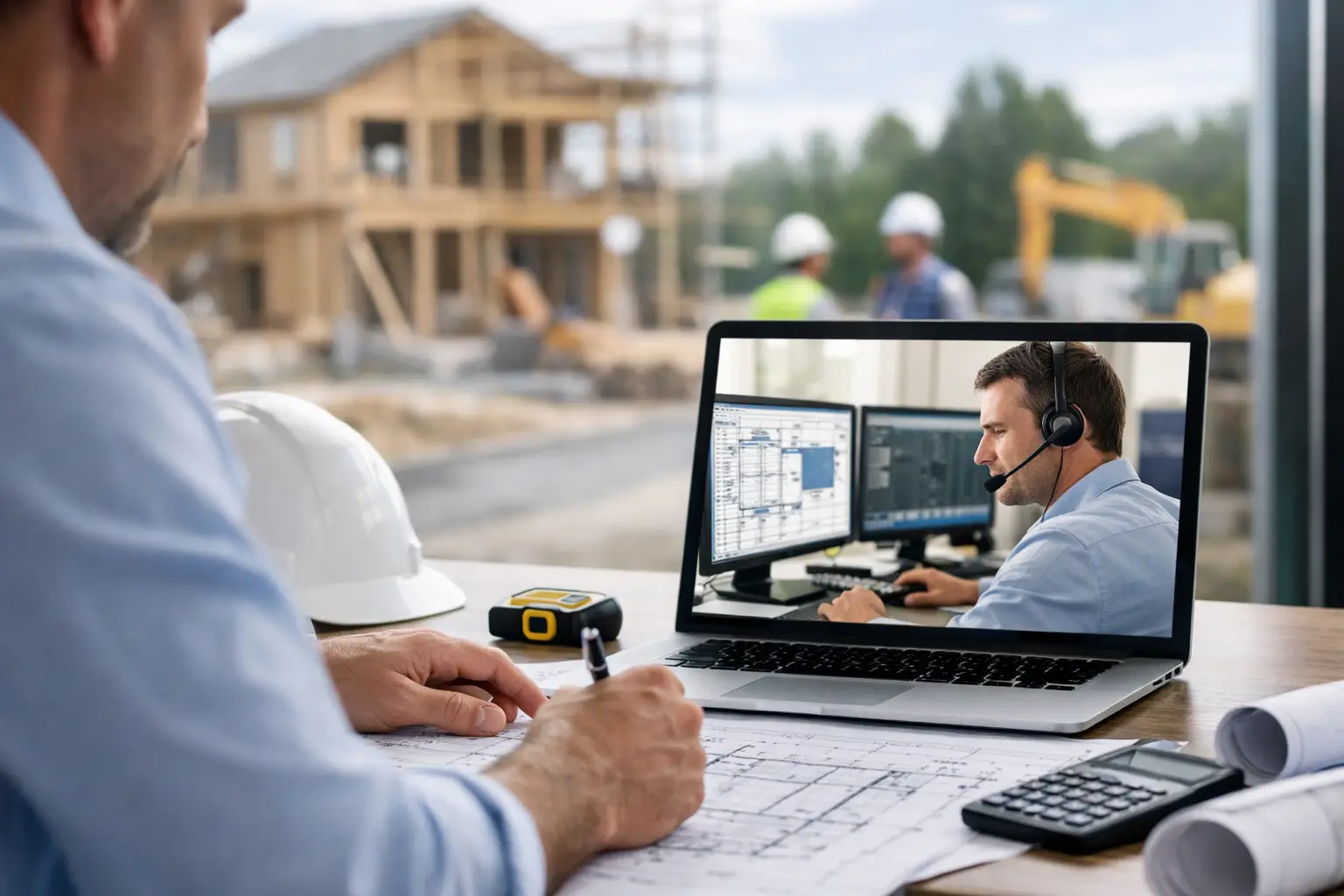
A bid deadline does not care that your lead estimator is on vacation, buried in takeoffs, or spending half the day answering supplier calls. The real question is when should builders outsource estimating: before missed opportunities become a pattern, or after margin pressure has already exposed the bottleneck?
For most builders, the answer is not “outsource everything.” Estimating is too tied to scope interpretation, purchasing relationships, and field reality for a blind handoff. But keeping every takeoff, material count, and bid worksheet in-house can become an expensive constraint when the pipeline grows faster than the team.
The strongest operators use outsourced estimating as flexible production capacity. They retain commercial control, scope judgment, and final pricing decisions while adding trained technical support where the work is repeatable, time-sensitive, and difficult to staff locally.
When Should Builders Outsource Estimating?
Builders should consider outsourcing when estimating demand is consistently exceeding internal capacity, when bid turnaround is slowing, or when the cost of adding full-time staff cannot be justified by the pipeline. The trigger is not simply being busy. Every construction business gets busy. The trigger is when estimating capacity starts limiting profitable growth.
That limitation often shows up before leadership sees it in a report. Sales teams stop pursuing smaller opportunities because the estimating department cannot absorb them. Project managers get pulled into takeoffs. Estimators work nights to meet deadlines, then have no time left for value engineering, subcontractor leveling, or scope review. The business may still be submitting bids, but it is doing so with less discipline and less margin protection.
Outsourcing can create immediate relief in those moments. It can also provide a long-term production model for builders that face seasonal volume swings, operate across multiple markets, or need specialized estimating support without waiting months to recruit and train locally.
Your bid volume is rising faster than headcount
A healthy pipeline can create its own operational problem. If bid invitations increase by 30% but the estimating team remains flat, the team must either work more hours, reduce the depth of review, or decline opportunities. None is a reliable growth strategy.
Outsourced estimators give builders a way to absorb volume without turning every new opportunity into a permanent payroll commitment. This is especially useful when growth is real but not yet predictable enough to justify two or three additional internal hires.
The best time to build that capacity is before the backlog becomes urgent. A trial project allows a builder to validate estimating quality, communication, file standards, and turnaround times while internal staff still have room to manage onboarding properly.
Bid turnaround is costing you work
Speed matters, but speed without accuracy is not a competitive advantage. Builders need enough time to review drawings, identify exclusions, compare supplier pricing, and submit a clean proposal. When estimates are repeatedly going out late, the business is competing from behind.
Outsourced support can take on time-intensive production work such as quantity takeoffs, material summaries, plan organization, alternates, and bid tabulation. That gives senior estimators more time to make the decisions that actually require their experience: interpreting risk, qualifying subcontractors, setting markups, and determining whether a job fits the company’s capacity.
A faster bid cycle also changes what the company can pursue. More capacity means teams can respond to invitations they would otherwise pass on, including repeat work from strong clients and strategically valuable projects in target markets.
Your estimators are doing work below their level
Senior estimators are expensive because they carry judgment. They understand how a detail on a drawing affects labor, material, sequencing, logistics, and risk. Using that judgment to manually count standard materials across a large set of plans is often a poor use of their time.
Outsourcing works best when builders separate technical production from commercial ownership. A dedicated external estimating team can handle defined takeoff and data-production tasks under established standards. Your internal estimator then reviews the output, applies local knowledge, confirms vendor and labor assumptions, and owns the final number.
That is not a loss of control. It is a more disciplined use of control.
The Margin Signals That Should Not Be Ignored
Estimating problems rarely announce themselves as an estimating problem. They appear as thinner margins, more change-order disputes, rushed buyouts, and jobs that look profitable on paper but underperform in the field.
If estimates are being completed under constant deadline pressure, assumptions are more likely to go undocumented. Scope gaps are more likely to survive until turnover. Material quantities may be checked once instead of twice. Those errors can cost more than the perceived savings of keeping every task in-house.
Outsourced estimating is not a substitute for a strong preconstruction process. It is a way to give that process the production capacity it needs. The internal team should still define assemblies, estimate templates, inclusions and exclusions, quality checks, and approval authority. Without those controls, an outside resource will only scale inconsistency.
Builders should also look at opportunity cost. If an overloaded team can only price five projects a month when it could competently pursue eight, the lost revenue potential may exceed the cost of dedicated estimating support by a wide margin. The right comparison is not outsourced cost versus an employee’s salary. It is outsourced cost versus missed bids, delayed proposals, overtime, recruiting expense, and avoidable estimate risk.
Where Outsourcing Delivers the Most Value
Not every estimating task should leave the building. Highly negotiated work, unusual scopes, final bid strategy, client-specific pricing, and projects with limited drawings often need direct internal ownership. The people closest to the client, the field crews, and the purchasing network should remain accountable for those decisions.
Outsourcing is strongest in structured, repeatable work with clear deliverables. Examples include detailed quantity takeoffs, lumber and material estimates, plan takeoff support, bid leveling, scope comparisons, drawing revisions, data entry, and standardized estimate updates. Builders using software such as Bluebeam, PlanSwift, On-Screen Takeoff, Excel, or ERP estimating systems can define workflows that make review and handoff straightforward.
The model is particularly effective for building materials suppliers, component manufacturers, and production-oriented builders. In those environments, volume is often high, specifications change quickly, and skilled estimating talent is difficult to find. A dedicated team can extend production across time zones and keep work moving after the local office closes.
What to Put in Place Before You Outsource
The difference between outsourced capacity and outsourced confusion is process. Before assigning work, builders need a clear operating framework.
Start with a representative trial project, not the most complex job in the pipeline. Provide current plans, addenda, bid instructions, estimating templates, sample completed estimates, and a written scope matrix. Define exactly what the team is expected to return and what remains with the internal estimator.
Establish a review cycle early. The first few estimates should receive close review, not because external teams cannot perform, but because every builder has unique conventions. One company carries waste differently. Another separates labor and material in a specific way. Another has preferred assemblies or supplier coding. Those standards need to be documented, tested, and refined.
Communication should be direct and predictable. Assign one internal point of contact, set daily or milestone-based check-ins, and create a simple process for RFIs, drawing conflicts, and revisions. Offshore production succeeds when it is managed as an integrated extension of the estimating department, not as a disconnected vendor relationship.
All Points Technical is built around that model: specialized construction production teams, validated through trial work, then scaled around the client’s actual workload. The goal is to get productive capacity in place in days, not months, without giving up the controls that protect quality and margin.
The Trade-Off: Flexibility Requires Management
Outsourcing estimating is not automatic savings. It requires onboarding, standards, review time, and leadership attention. A builder with inconsistent files, unclear scopes, or no internal estimate review process may initially feel more friction, not less.
There are also projects where outsourcing may not be the right move. If your annual bid volume is low, your work is highly bespoke, or one experienced estimator can comfortably manage demand, adding an external team may create unnecessary process. Similarly, if a project depends on immediate site knowledge or confidential pricing strategy, keep those parts close to the internal decision-makers.
But for builders carrying a growing bid pipeline, the greater risk is often waiting too long. By the time an estimating manager says the team cannot keep up, valuable opportunities may already be going unanswered and experienced staff may already be nearing burnout.
The better move is to treat estimating capacity as a strategic variable. Build it before the next surge, test it against real work, and use it to keep your best people focused on the judgment that wins profitable projects.
Leave a Reply