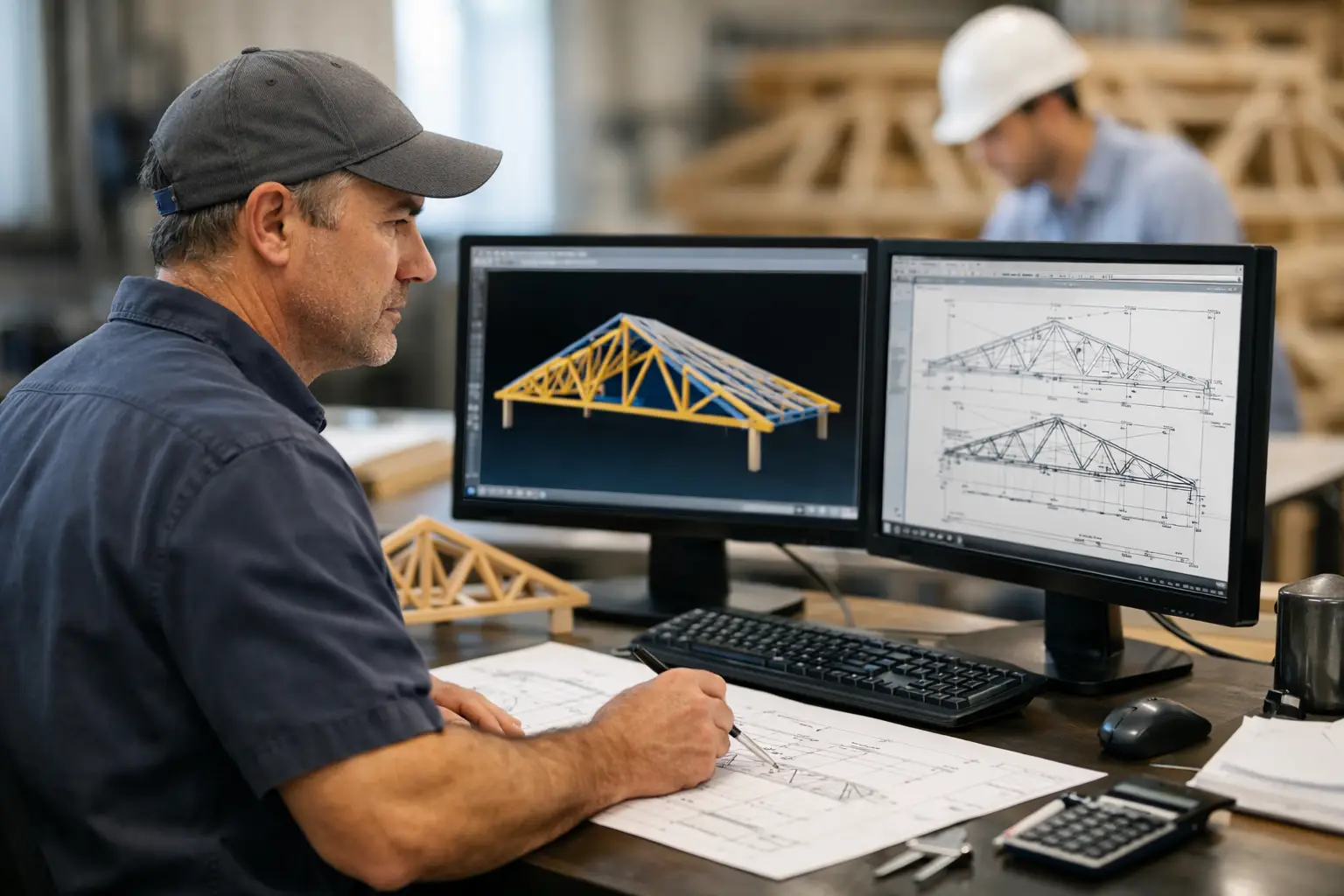
When a truss plant has sales in hand but design seats sitting empty, the problem is not demand. It is throughput. That is where truss designers who use Alpine software become a serious operational advantage. If your team runs Alpine and you cannot hire fast enough, every delayed layout, every backed-up queue, and every missed delivery window starts showing up in margin.
This is not just a software conversation. It is a capacity conversation. Alpine proficiency matters because your production flow depends on people who can work inside the platform without a long ramp-up, without constant correction, and without slowing down your in-house team. In a market where experienced truss talent is still hard to find, that kind of readiness changes the math.
Why truss designers who use Alpine software matter
Alpine is not a line item on a resume. For truss operations, it is part of the engine that drives quoting, design turnaround, manufacturing coordination, and downstream delivery. A designer who already knows the environment can contribute faster than a general CAD user or a structural professional trying to learn truss workflows on the fly.
That distinction matters most when volume spikes. If your plant is quoting aggressively, expanding into new builder relationships, or trying to clean up a backlog, you do not have time to teach platform basics while orders stack up. You need designers who understand the software and the production context around it.
Good Alpine designers also reduce friction between departments. Sales wants fast turnaround. Production wants designs that reflect reality on the floor. Management wants fewer redesign loops and cleaner output. A capable designer operating inside Alpine helps connect those priorities instead of forcing one department to absorb the cost of another department’s delays.
Alpine skill alone is not enough
A lot of companies make the same mistake. They look for software familiarity and stop there. But truss design is a production role, not a software demo.
The best truss designers who use Alpine software bring three things at once. First, they know the platform well enough to work efficiently. Second, they understand truss design principles, loading logic, and component behavior. Third, they can function inside a real operating environment where deadlines, revisions, and builder expectations are moving at full speed.
That combination is what separates usable talent from expensive headcount. Someone may know where the buttons are in Alpine and still create bottlenecks if they do not understand plant standards, engineering review expectations, or how to produce clean, buildable work. On the other hand, a strong designer with real truss experience can often adapt quickly to company-specific rules, naming conventions, and customer preferences.
Where the business impact shows up
If you are an owner, operations manager, or design lead, the value is not abstract. It shows up in output.
When Alpine-capable designers are in place, bid capacity improves because estimating and design do not choke at the same point every week. Turnaround improves because fewer jobs are waiting for scarce internal staff. Your lead team gets breathing room because senior people can focus on exceptions, problem jobs, and customer escalation instead of spending all day trying to keep the queue alive.
Margins improve too, but only if the staffing model is right. A bad hire burns money in training time, rework, and internal supervision. A productive Alpine designer increases billable throughput and helps the business take on more work without forcing a full local recruiting cycle every time volume rises.
There is also a less obvious gain: continuity. Plants that depend on a small number of local designers are exposed when one person quits, takes leave, or gets overloaded. Expanding access to trained Alpine talent gives your operation more resilience. That matters just as much as speed.
Hiring locally vs. adding external Alpine design capacity
For some businesses, local hiring is still the right move. If you need a long-term design manager, deep customer-facing coordination, or someone physically embedded in plant operations, an in-market hire may be the best fit.
But many companies are not dealing with a strategy problem. They are dealing with a timing problem. They need production now. They need jobs designed while recruiting continues, not after. In those cases, adding external design capacity can outperform traditional hiring because it removes months of delay.
This is where offshore and distributed production models have become far more practical than many decision-makers assume. The old concern was quality control. The current reality is that specialized partners with truss-specific recruiting, training, and workflow discipline can deliver Alpine-ready designers much faster than most companies can hire on their own.
That does not mean every offshore model is equal. It depends on how well the provider understands truss operations, how they screen software skill, how trial work is handled, and how quickly they can match designers to your standards. If the provider is just filling seats, you will feel it immediately. If they are built around construction technical production, the difference is obvious.
What to look for in truss designers who use Alpine software
If you are evaluating candidates or outside support, look beyond the software label. Ask how they handle design revisions, loading changes, and coordination with internal engineering or production teams. Ask what kind of truss volume they have supported. Ask how they manage plant standards and QC.
You are trying to measure operational fit, not just digital familiarity.
A strong Alpine designer should be able to enter your process with minimal drag. That includes understanding how to read incoming information, how to flag missing data early, how to keep work moving without creating risk, and how to work within your turnaround expectations. Speed matters, but clean speed matters more.
Communication also matters more than some teams admit. Truss design is technical, but it is still collaborative. If a designer cannot surface issues clearly, ask the right questions, or document changes properly, your in-house team ends up doing cleanup work. That defeats the point of adding capacity.
The best use case: scale without adding bottlenecks
The strongest case for Alpine-proficient design support is not replacing your internal team. It is extending it.
Most truss businesses already have experienced people in place. The issue is that those people are overloaded. They are handling design, customer questions, internal approvals, exception cases, and production support at the same time. Adding more work to the same core team does not create growth. It creates fatigue.
External truss designers who use Alpine software let you redistribute the load. Routine production can move faster. Internal experts can focus on supervision, higher-value review, and process control. That structure usually performs better than trying to solve every capacity problem with one more hard-to-find local hire.
It also gives management more flexibility. You can scale up when order volume rises, stabilize when it fluctuates, and avoid carrying unnecessary fixed overhead when demand softens. For businesses trying to protect margin while staying aggressive in the market, that flexibility is a real advantage.
Why onboarding speed changes the decision
A slow onboarding process kills momentum. If a staffing solution takes months to become useful, it is not a solution.
That is why specialized truss support partners outperform general staffing models. They know how to validate software proficiency, test technical fit, and get people into production quickly. The point is not to make a hire and hope for the best. The point is to prove capability early, reduce risk, and build a team that can actually carry work.
This is one area where companies like All Points Technical have changed buyer expectations. Instead of treating truss design like a generic recruiting function, they treat it like a production pipeline problem that needs a faster answer. That is the right lens.
The real question is not software. It is output.
Yes, Alpine knowledge matters. But the companies that win with this model are not obsessing over software in isolation. They are asking a harder and more useful question: can this person or team help us design more jobs, turn work faster, reduce strain on our key people, and support growth without dragging down quality?
That is the standard.
If the answer is yes, Alpine proficiency becomes part of a bigger business result. More bids out the door. Better use of internal leadership. More stable production. Less dependence on a painfully tight local labor market.
For truss operations under pressure to move faster, that is not a nice-to-have. It is the difference between capping growth and staying built for it.
The strongest operators do not wait for the hiring market to improve before they expand capacity. They build a model that keeps work moving anyway.
Leave a Reply