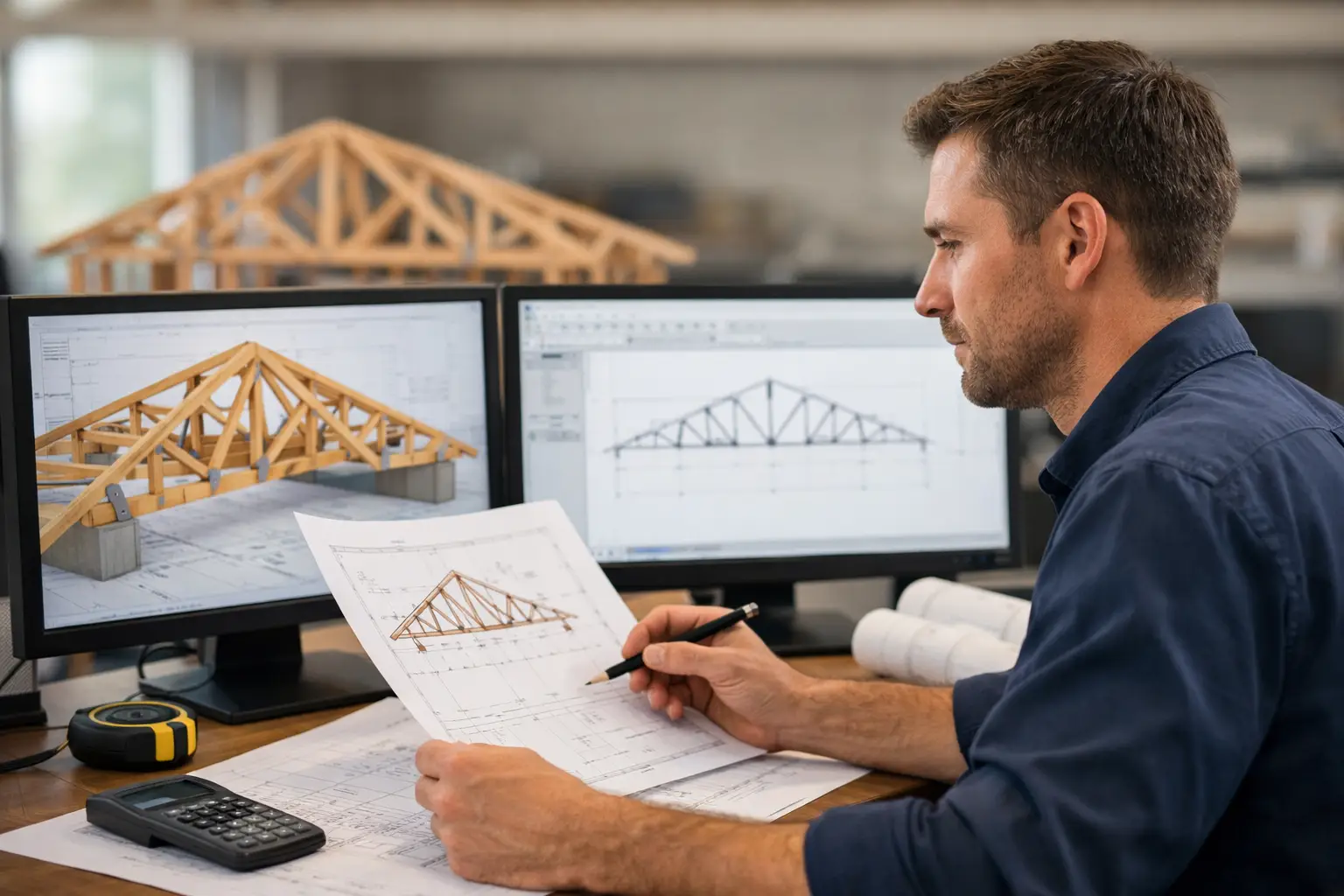
When a truss queue starts backing up, software familiarity stops being a nice-to-have and becomes a production issue. That is exactly why truss designers who use Simpson truss software are in such high demand. Plants, lumber dealers, and component manufacturers do not need general drafting help. They need designers who can step into active production, work inside established workflows, and keep jobs moving without a long learning curve.
This is not a small distinction. In truss operations, the difference between a designer who knows the platform and one who needs weeks of ramp-up time can show up in missed bid windows, delayed approvals, overloaded internal checkers, and margin erosion. If your business runs on throughput, software-specific capability matters.
Why software-specific truss design talent matters
Truss design is never just about drawing a profile. It sits at the intersection of engineering rules, manufacturing constraints, customer deadlines, pricing pressure, and plant capacity. A designer who understands truss loading and layout but does not know your software environment can still slow production. They may understand the theory and still struggle with the actual output your operation depends on.
That is why hiring managers increasingly look for truss designers who use Simpson truss software instead of casting a wide net for generic design talent. The goal is not just to fill a seat. The goal is to add useful capacity.
Useful capacity means a designer can read plans quickly, build accurate models, respond to revisions, coordinate with estimators and sales teams, and produce files that fit downstream production requirements. If they can do that inside the software your team already uses, the value is immediate.
What operations leaders are really buying
Most companies say they need designers. What they actually need is output. They need more quotes turned around, more jobs released, fewer bottlenecks in checking, and less overtime pressure on senior team members.
That changes how you should evaluate talent. The strongest candidates are not always the ones with the longest resume. They are the ones who can work in your production rhythm. They understand how truss packages move from plan intake to design to review to manufacturing release. They know that accuracy matters, but speed matters too. And they can balance both without creating cleanup work for the rest of the team.
This is where software experience becomes commercial, not just technical. A designer who already works in Simpson truss software can reduce friction across the whole chain. Fewer clarifications. Faster edits. Better consistency. Less time spent on avoidable corrections.
Where companies get stuck hiring truss designers who use Simpson truss software
The market is tight, and it has been for a while. Good truss designers are hard to find. Good truss designers with direct platform experience are even harder to hire locally, especially if you need more than one.
The first problem is supply. Experienced component design talent is limited in many US markets, and the same employers are often competing for the same people. The second problem is timing. Recruiting, interviewing, training, and onboarding can take months, while backlog pressure builds in real time. The third problem is variability. Even when a candidate has truss experience, their software background may not match your environment closely enough to create immediate value.
This is why many operations teams stall out. They know they need production support, but traditional hiring moves too slowly. By the time a role is filled, the business has already lost speed, stretched managers thin, or passed on work it could have won.
What strong Simpson truss software designers look like
A solid hire does more than open files and place members. They understand production logic. They can interpret architectural and structural documents without constant hand-holding. They know when a condition needs escalation and when it simply needs efficient resolution.
They also respect the reality of plant operations. Designs are not created in a vacuum. Plate selection, material availability, lead times, manufacturing preferences, and internal standards all shape the final output. Designers who perform well in real businesses understand those constraints and do not treat them as afterthoughts.
Communication is another separator. In high-volume environments, the best designers are concise, responsive, and easy to manage. They flag issues early. They do not bury risk. They do not disappear when revisions hit. They help keep the line moving.
The trade-off between hiring locally and scaling differently
For some companies, a local full-time hire is still the right move. If you need on-site collaboration every day, have a stable long-term backlog, and can absorb the recruiting timeline, building internally may make sense.
But that model has limits. It is expensive, slow to scale, and vulnerable to turnover. It also creates pressure when workload swings. If demand drops, fixed labor costs remain. If demand spikes, one or two internal hires rarely solve the problem fast enough.
That is why many firms now use a blended model. They keep core leadership, checking, and customer-facing roles in-house while expanding design capacity through specialized external teams. In truss design, that approach often delivers better operational control than waiting on the local labor market to cooperate.
How to evaluate outside design support
If you are considering external truss designers who use Simpson truss software, the first question is not price. It is readiness. Can they step into your workflow without creating management drag?
Look at software fluency, yes, but also ask how the team handles markups, revisions, internal QC, and communication across time zones. Ask how work is validated before scaling. Ask whether you are getting a generic staffing vendor or a partner that actually understands truss production.
That distinction matters. In specialized construction workflows, general staffing models tend to break down. The learning curve is too steep, the quality risk is too high, and the cost of errors shows up fast. You want a team that already knows the discipline, the pace, and the standards.
A serious provider should be able to show a clear ramp process. Trial work. Measurable output. Flexible staffing levels. Fast adjustment if your pipeline changes. This is where experienced technical production partners separate themselves from resume brokers.
Why offshore and distributed teams are now a practical option
There was a time when offshore technical support sounded risky to many construction businesses. That time is over. The model works when it is built around process, software proficiency, and industry-specific management.
For truss businesses, the upside is straightforward. You gain access to trained designers without waiting months for local recruiting. You create more production continuity across time zones. You increase bid and design capacity without building an oversized fixed-cost team.
Of course, it depends on execution. Offshore support only works if the partner understands US construction documents, truss workflows, customer expectations, and quality control. If that foundation is weak, lower labor cost does not help. If the foundation is strong, the model can outperform traditional hiring on speed, flexibility, and margin protection.
That is why companies with sustained backlog pressure are moving toward specialized technical staffing partners, not generic outsourcing shops. Firms such as All Points Technical built their model around exactly this problem: finding and deploying trained production talent in hard-to-fill disciplines fast enough to matter.
How the best companies use truss design capacity
High-performing truss businesses do not wait until they are overwhelmed to solve capacity issues. They treat design bandwidth as a growth lever. If they can quote faster, release work faster, and maintain quality under load, they can pursue more business with confidence.
That mindset changes the conversation. Instead of asking, “Can we find one more designer?” they ask, “How do we build a design engine that scales with demand?” Sometimes that means adding in-house talent. Sometimes it means augmenting with external software-ready designers. Often it means both.
The point is not to protect an old staffing model. The point is to keep production moving and margins intact.
A better standard for hiring truss design talent
If your operation depends on speed, software-specific capability should be a baseline requirement, not a bonus. Truss designers who use Simpson truss software can contribute faster, reduce friction sooner, and help your team absorb more work without the same level of operational strain.
That does not mean every candidate with platform experience is the right fit. It means your evaluation criteria should reflect the real job: production throughput, technical accuracy, communication discipline, and the ability to perform inside your workflow from day one.
The companies winning more work right now are not just hiring designers. They are building capacity on purpose, with the tools, systems, and people that let them stay aggressive when the market gets tight.
Leave a Reply