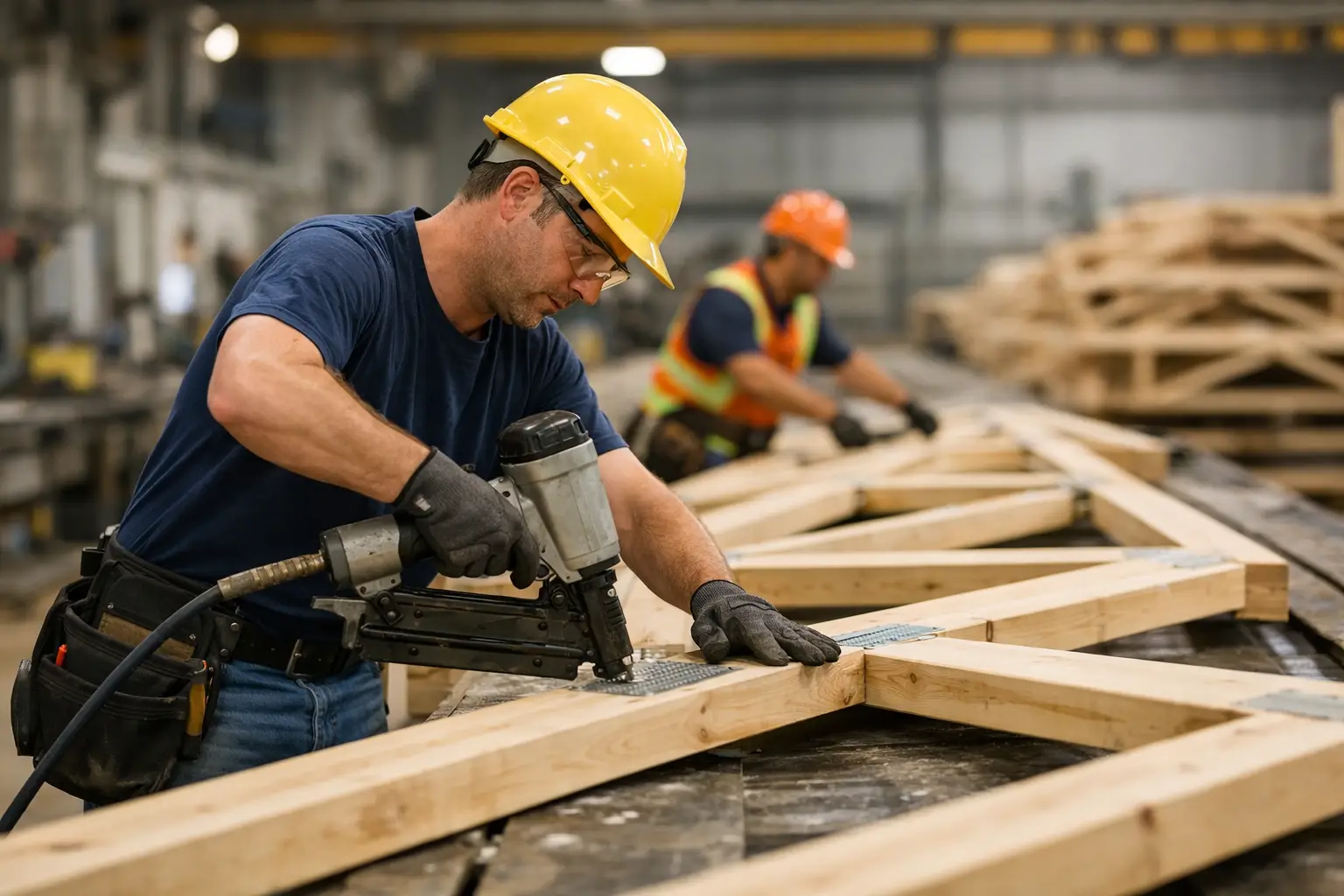
When a truss plant misses margin, direct labor is usually in the middle of the story. Not because labor is the only cost that matters, but because truss plant direct labor touches almost every operational result that leaders care about – throughput, quality, scheduling, overtime, rework, and the real cost of every job that leaves the yard.
That is why smart operators do not treat direct labor as a line item to squeeze. They treat it as a production system to manage. The plants that win are not always the ones with the cheapest crews. They are the ones that can align labor hours with demand, protect quality under pressure, and keep output moving when hiring gets tight.
What truss plant direct labor actually includes
In most operations, truss plant direct labor means the hands-on production work tied directly to manufacturing components. That usually includes saw operators, jig setters, assemblers, press operators, stackers, repair personnel, forklift support tied closely to production flow, and sometimes lead hands whose time is spent primarily on the floor.
What does not always fit cleanly into the bucket is where many plants get distorted data. Plant supervisors, maintenance, yard logistics, quality control, and design support may be coded differently from one company to the next. If one location loads setup time into direct labor and another pushes it into overhead, comparing labor performance across plants becomes messy fast.
That matters because bad categorization leads to bad decisions. If leadership thinks one plant is labor-efficient when it is really just coded differently, they will chase the wrong fix.
Why direct labor is the number everyone watches
Material cost usually gets the most attention in component manufacturing, and for good reason. Lumber and plate pricing can move hard and fast. But direct labor is where operators still have room to influence outcomes every week.
Labor performance affects capacity in a direct way. If labor productivity slips, promised lead times start stretching. If training is weak, errors rise and remakes eat margin twice. If overtime becomes the default answer, labor cost climbs while fatigue drives more mistakes onto the floor.
This is also where demand volatility shows up first. A plant can carry strong backlog one month and then get hit with mix changes, difficult profiles, labor gaps, or design bottlenecks the next. Direct labor becomes the pressure gauge for everything upstream and downstream.
The real drivers behind truss plant direct labor cost
A lot of plants still talk about labor as if hourly wage is the whole equation. It is not. Wage rate matters, but labor cost per truss, per set, or per thousand board feet is shaped by much more than pay.
Product mix is a major factor. A steady run of repeatable roof trusses behaves very differently from highly variable floor systems, complex girder packages, or jobs with frequent revisions. Plants with tougher work can look less efficient on paper even when they are operating well.
Layout and material flow matter too. If crews spend too much time waiting on cut parts, hunting for plates, moving finished bundles, or resetting stations, the plant is paying direct labor for nonproductive minutes. Those minutes compound across the shift.
Training depth is another big one. A veteran table crew can absorb job variation and keep pace under pressure. A thin bench with too many new hires cannot. Plants feel that gap in output first, then in quality, then in customer callbacks.
Scheduling discipline also changes labor performance more than many leaders admit. Plants that overload one day and starve the next create waste even with good people on the floor. Smoother release planning usually beats heroic overtime.
Labor shortages changed the game
For years, many component plants tried to solve growth with local hiring alone. That approach is now harder, slower, and more expensive in many markets. Skilled production workers are tough to find. Skilled truss designers, estimators, and technical support staff are even tougher.
This matters because plant labor efficiency is not just a floor problem. When design release lags, the floor stalls. When estimating falls behind, bid volume suffers. When engineering coordination gets backed up, production sequencing breaks down. What shows up as a direct labor issue may actually start in technical staffing.
This is where strong operators separate themselves. They stop viewing labor in isolation and start looking at the full production chain, from quote to design to cut lists to shop output to delivery.
Why cutting labor too hard usually backfires
Every plant wants a lean labor model. No serious operator wants bloat. But there is a difference between lean and exposed.
If crews are cut too far, small disruptions become expensive fast. One absent lead, one bad release package, one late material lane, and the shift falls apart. Plants then make up the difference with overtime, rushed repairs, premium freight, or delayed jobs. The payroll line may look cleaner for a week, but margin erosion shows up somewhere else.
The same is true when leaders delay technical staffing because they want to avoid fixed cost. If design capacity is too tight, production labor ends up paying for it through idle time, sequencing issues, and remake risk. Cheap staffing decisions can become expensive plant decisions.
A better way to improve direct labor performance
The best plants improve truss plant direct labor by attacking the causes of waste, not just the visible hours. That starts with clean measurement. If labor is tracked inconsistently, there is no reliable baseline. Plants need to know what hours belong in direct labor, what output those hours produced, and where productivity changes by shift, line, and product type.
Then comes workflow. If design release is unstable, fix release discipline. If saw bottlenecks choke assembly, fix cut flow. If setup times are excessive, standardize jig strategy where possible. If one supervisor consistently outperforms another with the same headcount, study the process difference instead of assuming it is luck.
Cross-training helps, but only when it is intentional. Rotating people without a plan can create average performance everywhere and mastery nowhere. The better model is to build depth in critical positions while keeping enough flexibility to cover peaks and absences.
There is also a strong case for separating core plant labor from scalable technical production support. Floor labor must be close to the work. But design, estimating, detailing, and selected production support functions can often be scaled faster through specialized external teams. That gives plants more room to stabilize release flow without waiting months to hire locally.
The margin impact leaders should care about
Direct labor is not just an efficiency metric. It is a growth constraint. If a plant cannot control labor performance, it cannot scale output confidently. That hurts more than current jobs. It reduces bid appetite, limits customer acceptance, and forces leadership into defensive decisions.
On the other hand, when labor performance is under control, the plant gains options. It can take on more volume, quote more aggressively, and absorb schedule pressure without losing discipline. That is where better margins come from – not from pushing crews harder, but from building a system that produces repeatable output.
For many businesses, that system now includes a mix of local leadership, disciplined plant operations, and external technical production support. All Points Technical has built its business around that exact gap: helping construction and component manufacturers increase capacity without waiting on impossible hiring timelines. For operators dealing with direct labor pressure, that kind of model is not a workaround. It is a practical way to keep production moving.
What good looks like in practice
A healthy labor model in a truss plant is not perfect. It still has hard weeks, staffing gaps, and ugly jobs. But it has visibility, accountability, and enough support to prevent small issues from becoming margin leaks.
Good plants know their labor numbers, but they also know what is behind them. They can explain whether performance moved because of product mix, release timing, training gaps, or poor scheduling. They do not confuse activity with output. And they do not expect floor labor to compensate for weak planning upstream.
That is the bigger point. Truss plant direct labor is one of the clearest signals in the operation, but it is rarely a standalone problem. When leaders read that signal correctly, they make better staffing decisions, build stronger production flow, and protect margin where it actually lives – on the shop floor, in the design queue, and across the handoff between them.
If your labor line keeps getting blamed for every miss, it may be time to stop asking who is on the clock and start asking what the system is forcing them to overcome.
Leave a Reply