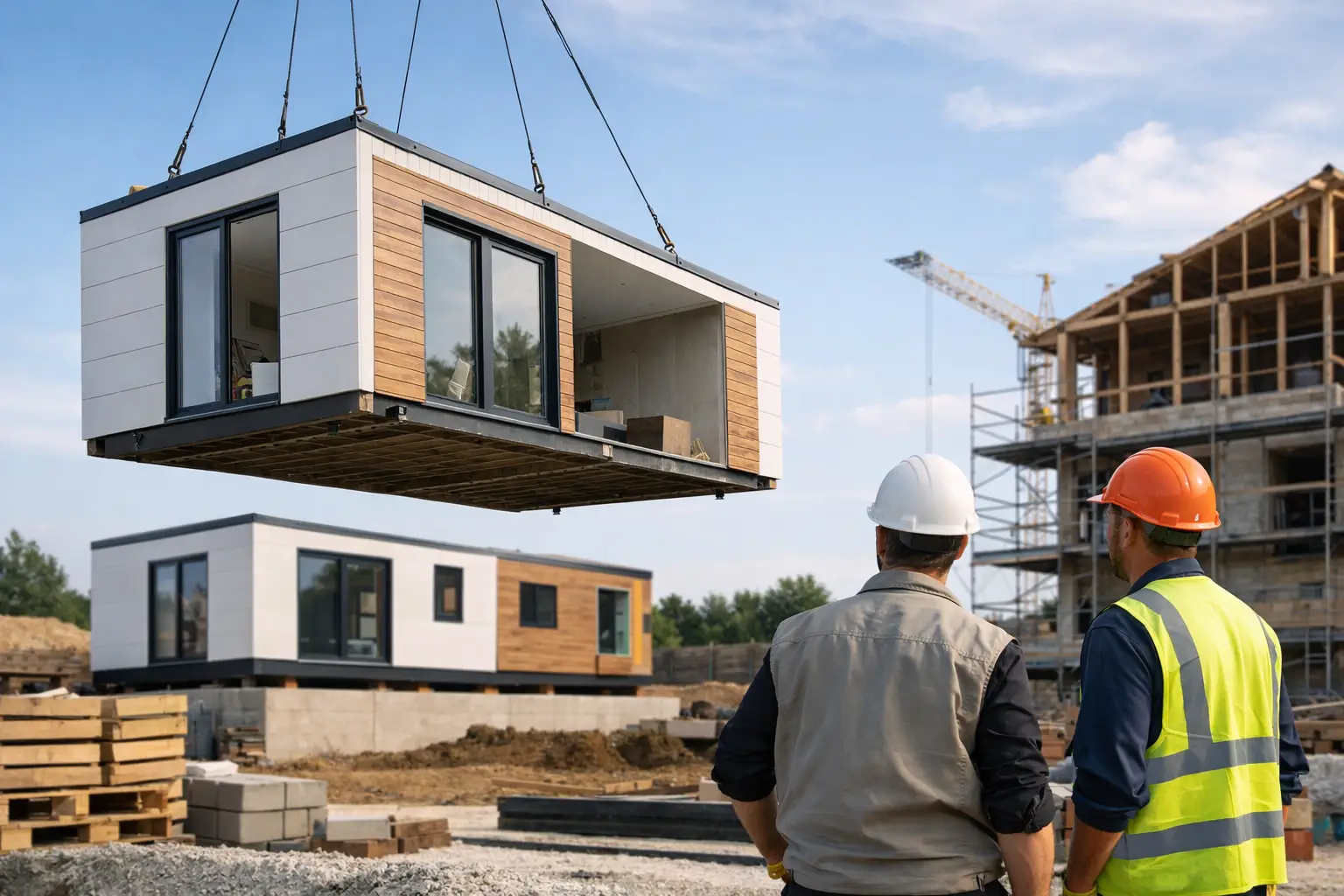
A modular homes project can leave the factory on schedule and still lose time, margin, and momentum before it ever reaches the site. That surprises people who focus only on manufacturing speed. The real pressure point is usually upstream – design throughput, plan standardization, material takeoffs, engineering coordination, and production-ready documentation.
That matters because modular is no longer a niche conversation. Builders, developers, and manufacturers are turning to off-site construction for a simple reason: traditional field-built timelines are hard to defend when labor is tight, schedules are compressed, and financing costs punish delays. But modular only performs when the technical side of the operation can keep pace.
Why modular homes keep gaining ground
The appeal is obvious. Modular homes shift a large share of construction into a controlled production environment, where weather is less disruptive, workflows are more repeatable, and labor can be used more efficiently. For companies trying to increase volume without increasing chaos, that model is attractive.
There is also a margin story here. Repetition, standardized assemblies, and factory processes can reduce waste and improve predictability. That does not mean every modular project is automatically cheaper than site-built construction. It means the business has a better chance of controlling variables that usually erode profit.
For operators, that distinction matters. Speed is valuable, but only if the back-end systems are disciplined enough to support it. A factory can frame, sheath, and finish modules at a strong clip. If the design team is buried, the estimating is inconsistent, or the shop package is incomplete, production slows down fast.
The promise of modular homes is real – and so are the constraints
Modular gets marketed as a faster path to housing, hospitality, multifamily, and workforce accommodation. In many cases, it is. But decision-makers who have actually scaled production know the model has hard operational requirements.
First, modular design has less tolerance for ambiguity. In a site-built project, some clashes or missing details get solved in the field, often at a cost. In modular, those issues multiply because components are fabricated earlier and more of the work is completed before delivery. If the design package is wrong, the error moves downstream faster.
Second, coordination is heavier than many teams expect. Structural systems, MEP pathways, transport limits, crane picks, module connections, code compliance, and finish sequencing all interact. That coordination burden does not disappear because the project is built in a plant. It becomes more front-loaded.
Third, growth exposes weak technical staffing. A manufacturer can sell more units, win more bids, or open a second line. None of that helps if design reviews, drafting, BIM modeling, or material estimating become the choke point. This is where many modular businesses hit a wall. Not because demand is weak, but because technical production cannot scale fast enough.
Where projects actually stall
The slowdown usually starts before fabrication. Sales teams secure opportunities. Operations commits to aggressive timelines. Then the technical queue fills up.
Plan development drags because standard models still need project-specific adjustments. Structural detailing gets backed up because engineering assumptions are not fully resolved. Estimating slows down because every design variation creates a new material logic. BIM teams get pulled in multiple directions as manufacturers, installers, and project stakeholders request changes on compressed timelines.
At that point, modular stops feeling fast.
This is the disconnect many companies miss. Off-site construction can compress field schedules, but it also demands a more mature preconstruction and production-support function. If your team cannot turn concepts into buildable documentation at speed, the factory becomes underfed. And an underfed factory is expensive.
The technical production model matters more than the factory tour
A lot of modular discussions stay focused on the physical plant: automation, floor layout, line efficiency, and output targets. Those are important. But they are only half the operating model.
The other half is technical production. That includes CAD and Revit work, structural and component detailing, material takeoffs, model coordination, plan revisions, and document control. If those functions are inconsistent, late, or understaffed, production capacity becomes theoretical.
This is why the strongest modular operators treat technical bandwidth as a core growth lever. They do not wait until the team is overloaded to solve it. They build workflows that can expand when bid volume rises and tighten when demand shifts.
For some firms, that means hiring internally. For others, it means using specialized technical partners who already understand construction documentation, component design logic, and the urgency of production schedules. The right answer depends on volume, complexity, and how variable the pipeline is. But the principle is the same: if you want modular speed, you need technical output that moves at manufacturing speed.
Standardization wins, but only up to a point
Modular economics improve with repeatability. Standard plans, repeatable assemblies, and defined component libraries reduce friction across design, procurement, and production. That is one reason modular works well for productized housing lines, hospitality units, student housing, and certain workforce or disaster-relief applications.
Still, standardization is not a free pass. Jurisdictional code differences, transportation constraints, customer customization, site conditions, and structural requirements can all force changes. Every exception puts pressure back on the design and detailing teams.
That is where disciplined systems outperform ad hoc heroics. A business that can manage revisions cleanly, maintain drawing standards, and produce accurate support documents at volume has a real edge. A business relying on a few overextended specialists will feel every exception as a delay.
Cost control depends on decisions made early
People often ask whether modular homes cost less. The honest answer is that it depends on product type, region, transportation, finish level, local labor rates, code requirements, and production scale. Modular can absolutely improve cost control, but only when the operation is set up to protect it.
Early-stage design decisions carry more weight in modular because they affect procurement, fabrication efficiency, transport, and installation. A change that looks minor on paper can trigger redesign, material shifts, or production sequencing problems. That is why accurate estimating and disciplined technical review are not support tasks. They are margin protection tools.
The companies that do this well understand something simple: cost certainty is built before the first module is assembled. It starts with drawings that are clear, coordinated, and ready for production.
What scalable modular operations do differently
High-performing modular businesses are usually not winning on one magic idea. They are winning on execution discipline.
They standardize what should be standardized and isolate customization where it adds value without disrupting the whole line. They shorten revision cycles. They build documentation processes that support manufacturing, not just permit submission. They make sure estimating, detailing, and production planning are connected instead of operating in silos.
Most importantly, they solve capacity before it becomes a crisis. When technical staffing is treated as an afterthought, growth gets capped by the smallest team in the process. When it is treated as a strategic production function, the business can take on more work with less friction.
That is where a specialized partner can make a measurable difference. For construction businesses pushing into modular or trying to scale an existing off-site operation, adding trained support across detailing, estimating, CAD, Revit, or BIM production can increase throughput without the delay of traditional recruiting. All Points Technical has built its model around that exact problem: helping construction firms remove technical bottlenecks so output can grow.
Modular homes are not just a product trend
They are an operating model test.
The market will keep rewarding builders and manufacturers that can deliver faster, with tighter quality control and better schedule predictability. Modular supports that goal, but only for companies that treat design capacity, documentation accuracy, and workflow continuity as core infrastructure.
If you are evaluating modular homes as a growth strategy, do not stop at the factory equation. Look at your technical pipeline. Look at how quickly your team can move from concept to coordinated production package. Look at where estimating, detailing, and model management begin to slip when volume rises.
That is where the real build bottleneck usually lives. Fix that, and modular becomes a serious scale advantage instead of just a promising idea.
The smartest move is not asking whether modular can grow. It is asking whether your technical production engine is ready when it does.
Leave a Reply