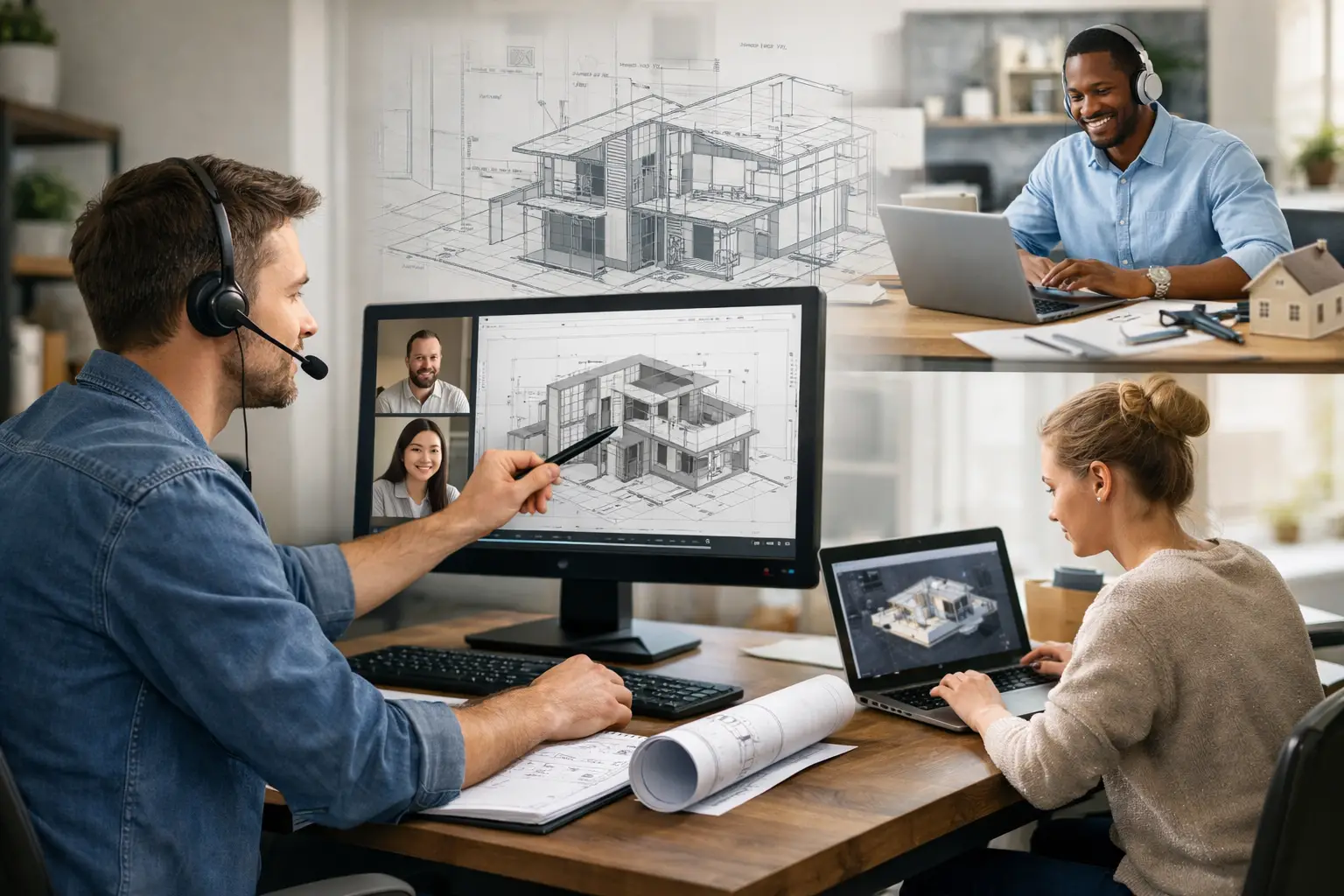
When a backlog hits, most construction businesses make the same mistake – they treat drafting capacity like a hiring problem. It is usually an operating model problem. If you want to know how to build remote drafting teams that actually raise output, protect quality, and keep projects moving, the answer is not simply adding more people. It is building a production engine with the right structure, standards, and accountability.
That matters more than ever in drafting-heavy environments. Revit, CAD, BIM coordination, structural detailing, shop drawings, and takeoff support do not slow down just because local recruiting does. If your pipeline is growing but your technical bench is thin, remote drafting teams can give you a faster way to expand capacity without waiting months for the perfect local hire.
Why remote drafting teams fail
Most failures come from bad design, not bad talent. Companies rush into remote staffing with a vague job description, weak onboarding, and no production owner. Then they blame geography when deadlines slip or revisions pile up.
Remote drafting work is highly process-dependent. Standards matter. File naming matters. Markup clarity matters. Model setup matters. If your internal team relies on tribal knowledge and hallway conversations, a remote team will struggle because the work was never truly systemized in the first place.
The other common issue is role confusion. Leaders say they need a drafter when they really need a coordinated mix of production drafting, redline execution, model cleanup, sheet production, QA support, and overflow capacity during bid peaks. If you hire one person to do five jobs, remote or local, performance will suffer.
How to build remote drafting teams that scale
The strongest remote drafting teams are built like operating units, not like temp labor. Start with demand, define the work, and then build a team around repeatable production.
Start with the production bottleneck
Before you decide who to hire, identify where work is actually getting stuck. For some firms, the bottleneck is BIM modeling. For others, it is shop drawing production, markups, clash updates, or construction document revisions. In estimating-driven environments, it may be preconstruction drafting support tied directly to bid volume.
This step sounds basic, but it saves time and money. A remote team built around the wrong bottleneck just creates more coordination overhead. A remote team built around the right bottleneck increases throughput almost immediately.
Measure the problem in business terms. Are you losing bids because turnaround is too slow? Are PMs waiting on revisions? Are your senior designers doing junior-level cleanup work? Those are signs that capacity is misallocated, and that is where a remote drafting team can create margin.
Define work by task type, not just by title
A title does not tell you enough. “CAD drafter” can mean ten different things across construction and structural workflows. To build an effective remote team, break the job into specific task categories and volume.
That may include model setup, annotation, redline incorporation, families or library management, detailing, sheet organization, quantity support, permit set updates, or as-built revisions. When you define work at that level, you can match talent more accurately and avoid overpaying for skills you do not need on every task.
This also helps you decide whether to start with one dedicated drafter, a small pod with QA coverage, or a blended team that supports both drafting and adjacent technical functions. It depends on your pipeline stability and how standardized your projects are.
Build around one system of record
Remote drafting teams perform best when there is no ambiguity about where files live, which version is current, and who approves changes. If your current workflow still depends on scattered email attachments and informal handoffs, fix that first.
You need one system of record for models, drawings, markups, revisions, and production status. That does not require a complicated tech stack. It requires discipline. Everyone should know where to pull work, where to post output, how to log issues, and when a file is ready for review.
The goal is simple: reduce interpretation. Remote production gets faster when process removes guesswork.
Hiring for remote drafting performance
Technical skill matters, but it is not enough. The best remote drafting teams combine software proficiency with production discipline, communication habits, and comfort working inside established standards.
Test real work, not interview polish
If you want predictable output, validate candidates with real production tasks. Give them a sample set, a markup package, or a model update exercise that reflects your actual workflow. Then evaluate speed, accuracy, and how well they follow instructions.
This matters because drafting is execution-heavy. Some candidates interview well but struggle with redline interpretation, layer discipline, naming conventions, or revision control. Trial work exposes that quickly.
An experienced staffing and production partner can compress this process by pre-vetting software skill, industry background, and output quality before the candidate ever reaches your desk. That is one reason specialized providers outperform general staffing firms in construction-facing technical roles.
Hire for overlap, then expand coverage
A lot of companies assume remote teams should work only while the US sleeps. That can help with turnaround, but full overnight separation is not always the best place to start. In early-stage onboarding, shared working hours matter. You want enough overlap for live questions, quick reviews, and standard-setting.
Once the team is stable, extended time zone coverage becomes a major advantage. Work can move from markup to production to review in a near 24-hour cycle. That is where remote drafting teams stop being a labor substitute and start becoming a real production asset.
Operating remote drafting teams without losing quality
The quality question is where most decision-makers hesitate, and fairly so. Drafting errors are expensive. A remote model only works when quality control is built into the workflow from day one.
Set production standards before volume ramps
Do not wait until the team is busy to define standards. Establish templates, annotation rules, dimensioning conventions, title block requirements, modeling expectations, QA checklists, and escalation paths early. If your standards are loose, rework will rise with every additional person you add.
This is especially true in industries where design output feeds downstream manufacturing, field installation, or procurement. A remote drafting team must understand not just what to draw, but what the drawing affects.
Use layered review, not heroic review
If quality depends on one senior person catching everything at the end, your process will break under load. Strong remote teams use layered review. Junior or mid-level drafters complete defined work packages. A lead checks against standards. A final reviewer clears high-risk output before issue.
That structure is more efficient than having your most expensive technical people redraw or heavily repair files after the fact. It also creates a training path, which makes scaling easier.
Track production with a few hard metrics
Do not overcomplicate performance management. You need visibility into turnaround time, revision rate, QA pass rate, output volume, and utilization. Those metrics tell you whether the team is actually improving capacity or just shifting work around.
The right benchmark depends on project type. High-complexity BIM coordination and repeatable drafting support should not be measured the same way. But every remote drafting team should be judged on speed, accuracy, and consistency.
What the best rollout looks like
If you are serious about how to build remote drafting teams, do not start with a massive rollout. Start with a controlled production test. Choose work that matters enough to prove value but is contained enough to manage closely.
A smart first phase usually lasts a few weeks. Assign a dedicated internal owner. Feed the team real tasks. Review output aggressively. Tighten standards. Then expand headcount only after the workflow is working.
This is where many construction firms gain confidence fast. Once they see that drafting output can be delivered accurately, on schedule, and at lower production cost, the conversation changes. Remote drafting stops looking like a workaround and starts looking like a growth strategy.
That is why experienced firms do not build these teams as one-off experiments. They build them to increase bid capacity, absorb volume spikes, protect key local staff from burnout, and keep technical production moving even when the domestic labor market is tight. All Points Technical has built its model around that reality for years, helping construction businesses get up and running in days, not months.
The companies that win with remote drafting are not the ones chasing the cheapest rate. They are the ones that design the team correctly, set clear standards, and treat drafting capacity as a strategic lever. If your business is hitting production limits, that shift is worth making now – before backlog turns into missed revenue.
Leave a Reply