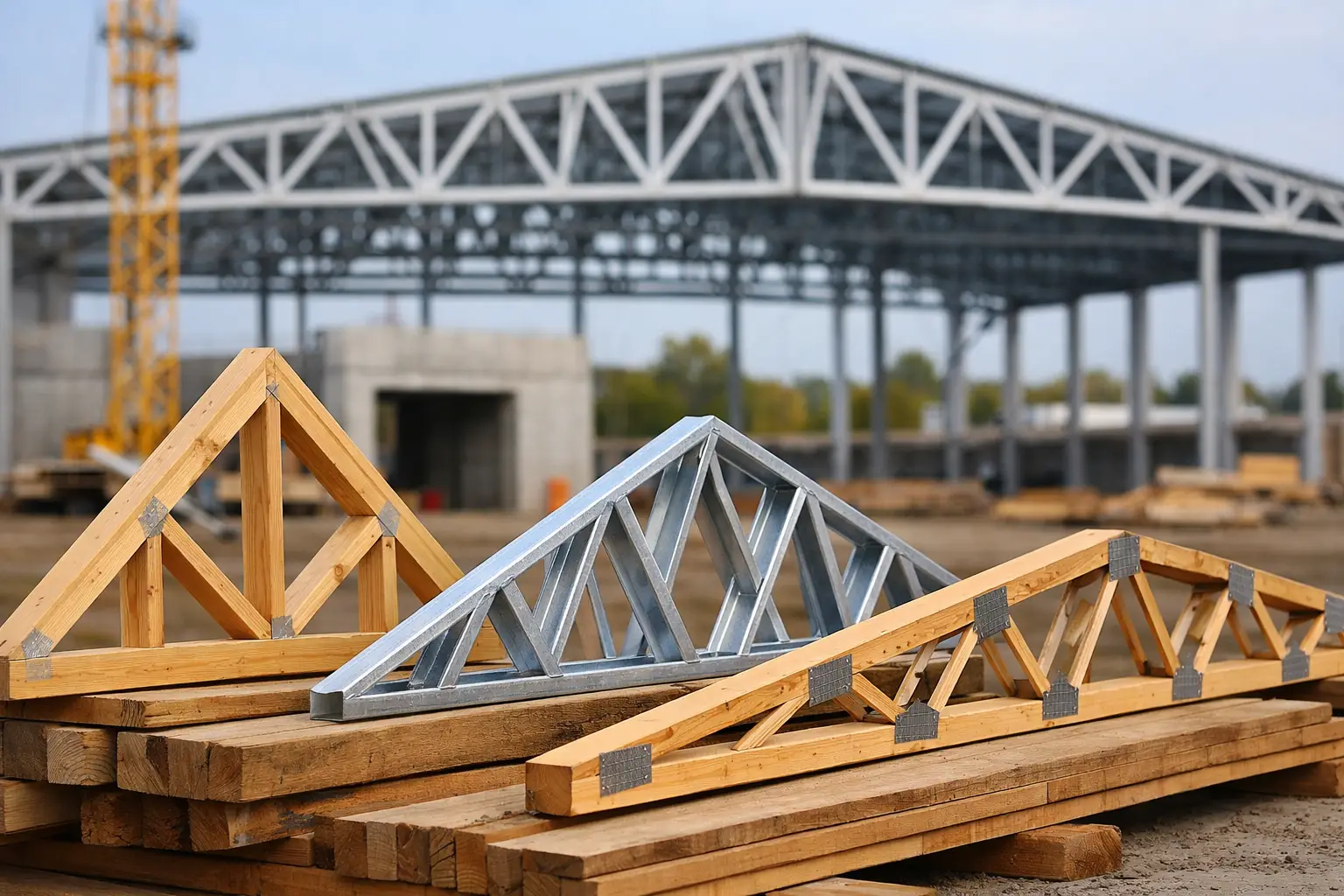
A truss package can look efficient on paper and still create problems in production, installation, or cost recovery. That usually starts with one issue: the wrong truss design types being applied to the wrong conditions. For truss plants, lumber dealers, component manufacturers, and builders trying to move faster without giving away margin, knowing how major truss forms behave is not academic. It is a production decision.
Why truss design types matter in real operations
Different truss configurations solve different structural and manufacturing problems. Span, pitch, loading, bearing conditions, web geometry, material optimization, and field handling all change what makes sense. A design that performs well for a residential roof may be a poor fit for a long clear-span commercial application. A truss that minimizes member count may still complicate plate placement, bracing, or shop throughput.
That is why experienced teams do not treat truss selection as a drafting exercise. They treat it as an operational lever. The right truss type supports cleaner engineering, predictable fabrication, faster installation, and fewer surprises in the field. The wrong one adds redesign cycles, production friction, and callbacks nobody wants.
The main truss design types and where they fit
King post truss
The king post is one of the simplest truss forms. It typically works best over shorter spans and uses a central vertical member with angled top chords. Its value is straightforwardness. It is easy to understand, efficient for small structures, and often economical when the span is limited.
But simple does not mean universally useful. Once spans increase, the king post quickly reaches its practical limits. For production teams, it is rarely the answer when projects demand larger open spaces or more complex loading conditions.
Queen post truss
The queen post truss extends the concept by using two vertical posts instead of one. That allows somewhat longer spans than a king post while maintaining a relatively clean layout. It is often chosen where a simple, traditional geometry still needs a bit more reach.
The trade-off is that it remains a moderate-span solution. If a project needs significant open area or heavy loading, other truss forms usually outperform it. In practice, it can be a useful middle ground, but not a high-capacity answer.
Fink truss
In residential work, the Fink truss is one of the most common roof truss forms for a reason. Its web pattern creates strong triangulation, making it efficient for standard pitched roofs. It tends to provide a solid balance of structural performance, material use, and production familiarity.
This matters to high-volume operations. Familiar truss profiles reduce design ambiguity, streamline shop processes, and support repeatability. If your business depends on throughput, the Fink often earns its place because it is proven and production-friendly.
That said, a Fink truss is not automatically the best answer for custom roof geometry, attic use, or long-span commercial needs. Standardization helps margins, but only when it fits the actual building.
Howe truss
The Howe truss uses diagonal members that slope toward the center, paired with vertical web members. It has a long history in structural applications and can perform well where timber compression members are advantageous. Depending on the project, it may offer a practical and durable layout.
Its usefulness today depends on context. In some component design environments, other truss patterns are more common because they align better with current fabrication preferences or standard residential packages. Still, the Howe remains relevant when loading and geometry support its strengths.
Pratt truss
The Pratt truss reverses the diagonal orientation seen in the Howe. It is often associated with efficient tension behavior in the diagonals and has broad structural relevance, especially in larger-span applications. In certain roof and floor systems, it can be a strong performer.
For construction businesses, the key point is not memorizing textbook differences. It is knowing when the load path, span, and support conditions make Pratt geometry a better fit than other options. That decision affects engineering confidence and fabrication efficiency at the same time.
Warren truss
The Warren truss is recognized by its repeating triangular pattern, often with fewer vertical members. It distributes loads efficiently and can be effective for longer spans. Its clean geometry also appeals in applications where repetitive structure is useful.
But there is no free lunch. Depending on the exact loading pattern, connection detailing and deflection behavior may require closer review than a more conventional layout. If loads are not uniformly distributed, what looks simple can become more nuanced in analysis.
Scissor truss
Scissor trusses are used when the design calls for a vaulted or cathedral-type ceiling while retaining a trussed roof system. Architecturally, they open up interior space. Commercially, they let builders create a higher-value interior feel without switching to a completely different structural strategy.
The catch is that scissor trusses introduce more design coordination. Ceiling slope, roof slope, heel conditions, insulation requirements, and bracing all need to work together. They can absolutely be the right answer, but they demand accuracy up front.
Attic truss
An attic truss is designed to create usable space within the roof system. For builders trying to add square footage efficiently, this can be a smart move. It turns the truss cavity into a functional area rather than dead space.
From a design and manufacturing standpoint, attic trusses are more demanding than standard common trusses. The room opening changes load paths and member forces, which can drive up lumber requirements and connection complexity. The value is real, but so is the need for disciplined engineering and detailing.
Mono truss
Mono trusses support single-slope roofs and are common in additions, sheds, canopies, and contemporary rooflines. They are useful when the building geometry or drainage strategy calls for a one-directional slope.
Their simplicity can help, but only if bearing conditions and uplift demands are handled correctly. Mono systems often look easy from the outside. In design production, they still require careful attention to load transfer and attachment details.
Parallel chord truss
Parallel chord trusses are widely used in floor systems and flat or low-slope roof applications. Because the top and bottom chords run parallel, they are well suited to projects that need depth for mechanical runs, longer spans, or flat framing profiles.
For many commercial and multifamily applications, this is where truss strategy becomes a major operational advantage. Parallel chord systems can support layout flexibility and speed in the field. They can also become coordination-heavy if openings, service routing, or concentrated loads are not addressed early.
Choosing among truss design types is rarely just structural
The best choice usually sits at the intersection of engineering need and production reality. Span is the obvious starting point, but not the only one. Roof shape, ceiling profile, bearing layout, uplift exposure, transportation limits, install sequencing, and plant capacity all affect what should be designed.
This is where a lot of companies lose time. They focus on structural adequacy first and deal with manufacturability later. That approach creates rework. A truss that technically works but slows table setup, complicates jigging, or increases plate conflicts can quietly erode margin.
The stronger approach is integrated thinking from the start. Design teams, estimators, and production leaders need alignment on what the job is really optimizing for. Lowest board footage is not always the same as lowest total cost. Fastest design turnaround is not always the same as best field outcome.
What high-performing teams look for early
Experienced operations do a few things differently. They assess whether the project needs standardization or customization. They identify where geometry will create exceptions. And they pressure-test whether the selected truss form will remain efficient once engineering, fabrication, delivery, and installation are all considered.
That matters even more when volume increases. If your team is bidding aggressively or running multiple projects at once, truss selection cannot depend on whoever is available to draft that day. It needs process discipline. That is one reason companies use specialized technical production partners like All Points Technical – not just to add drafting capacity, but to keep design throughput aligned with manufacturing and growth targets.
Common mistakes when selecting truss types
One common mistake is forcing a familiar truss type into conditions it was not meant to handle. Another is overlooking field constraints, especially crane access, bracing demands, or delivery limitations. A third is treating custom geometry as a minor variation when it actually changes the design logic significantly.
There is also a commercial mistake that shows up often: underestimating the time cost of redesign. When workloads are heavy, every extra revision cycle affects bid velocity and plant scheduling. The better your team gets at matching truss type to application early, the more stable your operation becomes.
The right truss type supports scale
Truss design is not just about making a structure stand up. It is about making your business run better. The right truss type helps engineering move faster, keeps fabrication predictable, and reduces friction from estimate to install.
If you are evaluating truss design types, the smartest question is not which option is most common. It is which option gives your team the strongest combination of structural fit, production speed, and margin protection for the job in front of you. That is where better decisions start, and where better operations keep pulling ahead.
Leave a Reply