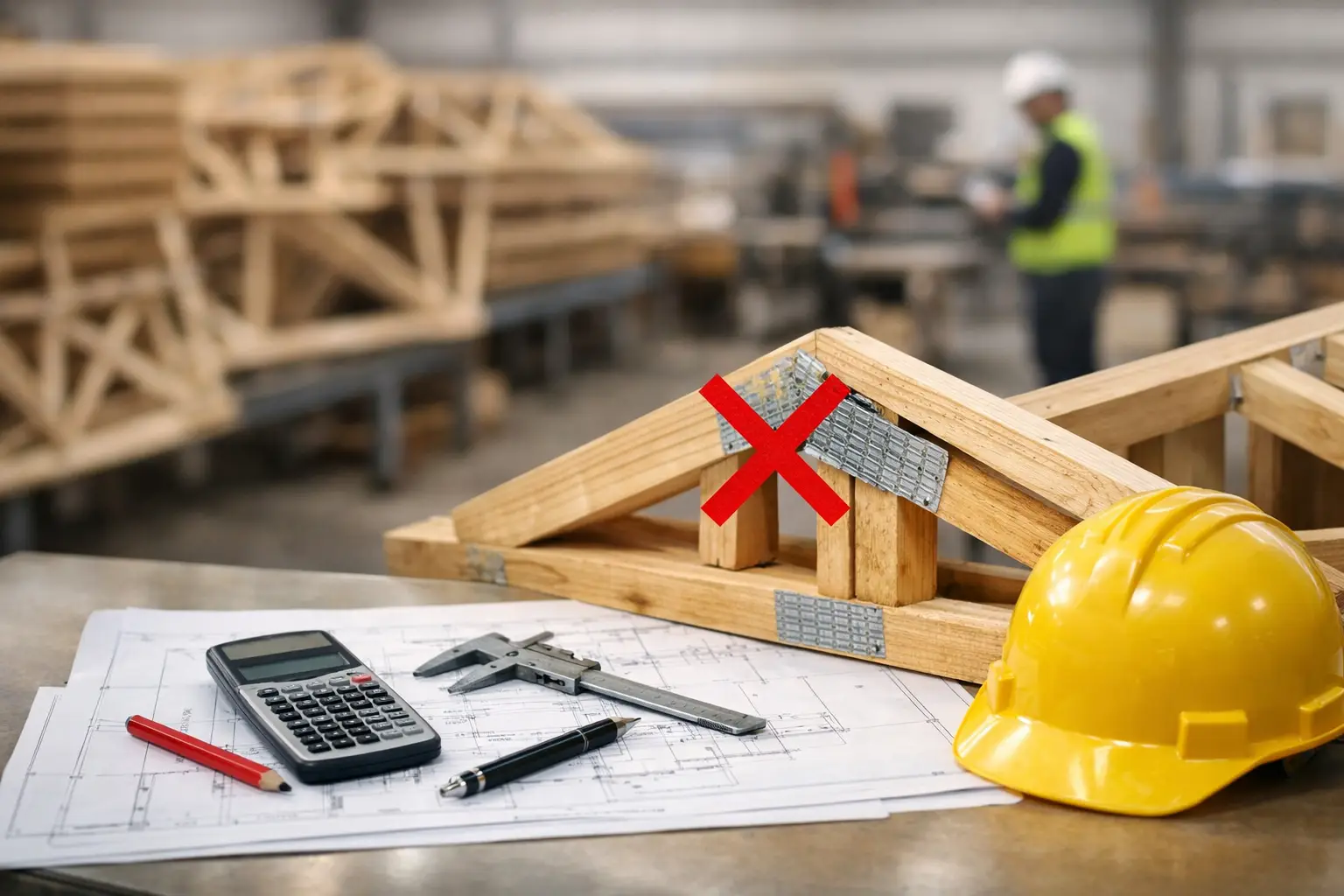
A truss job can look profitable at release and still lose money before the truck leaves the yard. Component design errors are rarely isolated drafting mistakes. They create shop-floor questions, rushed material changes, delayed deliveries, field calls, and a margin leak that compounds across the week.
For truss plants, component manufacturers, and lumber dealers, the issue is not whether errors can happen. They can. The real question is whether your design process catches them while correction is still cheap, or after production, delivery, and installation have already started. The difference is operational control.
The Component Design Errors That Hurt Margins
The highest-cost problems usually appear where information moves between people: from plans to estimating, estimating to design, design to production, and production to the field. Strong designers matter, but strong workflows matter just as much. Here are seven errors that deserve attention before they become production events.
1. Designing from incomplete or conflicting plan information
Architectural, structural, and MEP documents do not always agree. Roof geometry may differ between sheets. A beam callout can conflict with a framing plan. Mechanical openings may be absent from the initial set and appear in a later revision. When a component designer assumes rather than verifies, the truss package can be technically complete and still wrong for the building.
The best defense is not more guesswork. It is a defined clarification process. Designers need clear rules for identifying conflicts, documenting assumptions, and escalating questions to the correct party before final release. A request for information may feel like a delay, but it is usually faster than a field repair or a rebuilt order.
2. Missing critical loading conditions
Loading errors can come from using the wrong jurisdiction, overlooking concentrated loads, misreading attic storage requirements, or applying outdated criteria after a plan revision. These are not minor inputs. They drive member sizing, plate selection, web configuration, bearing demands, and the final engineering path.
Design teams should confirm the design criteria at the beginning of every job and recheck it when the scope changes. This is especially important on projects with multiple roof elevations, solar-ready areas, HVAC units, girder reactions, or unusual snow and wind requirements. A standard loading template helps, but it cannot replace project-specific review.
3. Incorrect bearing, support, or reaction assumptions
A truss can analyze successfully in software while still creating an installation problem if the assumed supports do not match the actual structure. Common examples include missed interior bearings, insufficient wall width, a girder reaction landing where no support exists, or a support condition altered by a last-minute framing change.
This is where close coordination with the framing plan and structural documents pays for itself. The designer needs to understand where loads travel after they leave the truss. If the support strategy is unclear, the job is not ready for release. Engineering review and clear field documentation are essential when reactions require special blocking, posts, hangers, or transfer details.
4. Poor web layout around mechanical and architectural constraints
A web pattern that works on a screen may block a duct run, interfere with a staircase opening, or complicate a vaulted ceiling detail. In some cases, the design is structurally acceptable but creates a field condition that nobody can install efficiently. That means lost time for the framer, calls to the plant, and pressure for changes after materials are cut.
The solution is early visibility. Mechanical zones, attic access, ceiling transitions, tray ceilings, and large openings should be identified before the truss layout is finalized. When there is a trade-off between the most material-efficient web pattern and the most buildable one, buildability often wins. Saving a few dollars in lumber is not a win if the field team loses hours working around the component.
5. Plate selection and manufacturing details that ignore reality
Connector plate issues can emerge when plate requirements, press capability, lumber condition, and production practices are not aligned. A design may call for an arrangement that is difficult to press consistently, leaves little tolerance for lumber defects, or creates confusion at the table. The result can be slower production, rejected pieces, and avoidable quality concerns.
Design should account for the plant’s actual manufacturing environment. That includes plate availability, equipment limits, standard jig practices, lumber grades, and the level of detail required on shop documents. This is not an argument for designing down. It is an argument for designs that can be produced correctly, repeatedly, and at speed.
6. Revision control failures
Few component design errors are more expensive than building from the wrong version. A revised plan can affect layouts, profiles, loading, bearings, girder locations, and quantities. If the estimating, design, production, and sales teams are not working from a clearly controlled document set, a plant can produce an obsolete package with complete confidence.
Revision discipline needs ownership. Every incoming change should be logged, reviewed for scope impact, and tied to an approved release process. The team should be able to answer three questions immediately: What changed? Which components are affected? Has production received the current information? If the answer is uncertain, the process is not protecting the margin.
7. Releasing work without a practical quality-control check
A quality-control review is not a ceremonial second set of eyes. It is the final operational check that connects the design to the estimate, plans, manufacturing process, and field requirements. When teams skip this step because the schedule is tight, they often trade a short-term gain for a larger disruption later.
The right QC process is targeted, not slow. It should verify high-risk items such as loading criteria, truss profiles, bearings, girder reactions, special details, quantities, layout coordination, and revision status. The depth of review depends on project complexity. A repeatable tract plan needs a different approach than a custom home, multifamily project, or commercial roof system. But every release needs a deliberate checkpoint.
Why Capacity Problems Create More Design Risk
Most plants do not accept avoidable design risk on purpose. It shows up when the design queue outgrows the team. Deadlines tighten, experienced designers become reviewers and firefighters, and newer staff are asked to carry work before the process can support them. The problem is not effort. It is capacity.
That is why technical staffing should be treated as a production strategy, not a recruiting exercise. When design demand rises, a plant needs qualified support that understands truss software, component workflows, lumber optimization, plan interpretation, and the pace of a live production operation. General CAD capacity is not enough.
A dedicated technical team can take repeat work, overflow packages, revisions, or defined design scopes off the internal team’s plate. That gives senior designers time to focus on complex jobs, customer coordination, engineering exceptions, and quality control. It also keeps bid velocity from collapsing when volume spikes.
The model matters. Throwing work to an unfamiliar resource without standards creates its own risk. A better approach starts with trial work, documented design rules, software and workflow alignment, clear communication channels, and measurable review criteria. Once quality is proven, capacity can scale with the pipeline instead of being limited by local hiring cycles.
All Points Technical supports this model with specialized component design teams built for construction production environments. The goal is straightforward: help plants move more work through design without lowering the standard that protects the shop, the customer, and the margin.
Build Error Prevention Into the Release Process
The strongest plants do not rely on individual heroics to prevent mistakes. They build a release process that makes critical information visible and makes escalation normal. That means a designer can flag an incomplete detail without being treated as the bottleneck, and a reviewer can stop a release when the support condition does not make sense.
It also means measuring the right outcomes. Track rework by cause, not just total rework. Watch how many hours are spent on post-release changes, how often shop questions trace back to documents, and which customers or project types generate the most revisions. Those patterns reveal whether the problem is training, intake quality, plan coordination, workload, or a missing control point.
The next time a design queue starts growing, do not wait for errors to expose the real cost of being understaffed. Add qualified capacity early, protect review time, and make every release prove it is ready for the floor. That is how a component operation grows without giving back its profit in rework.
Leave a Reply