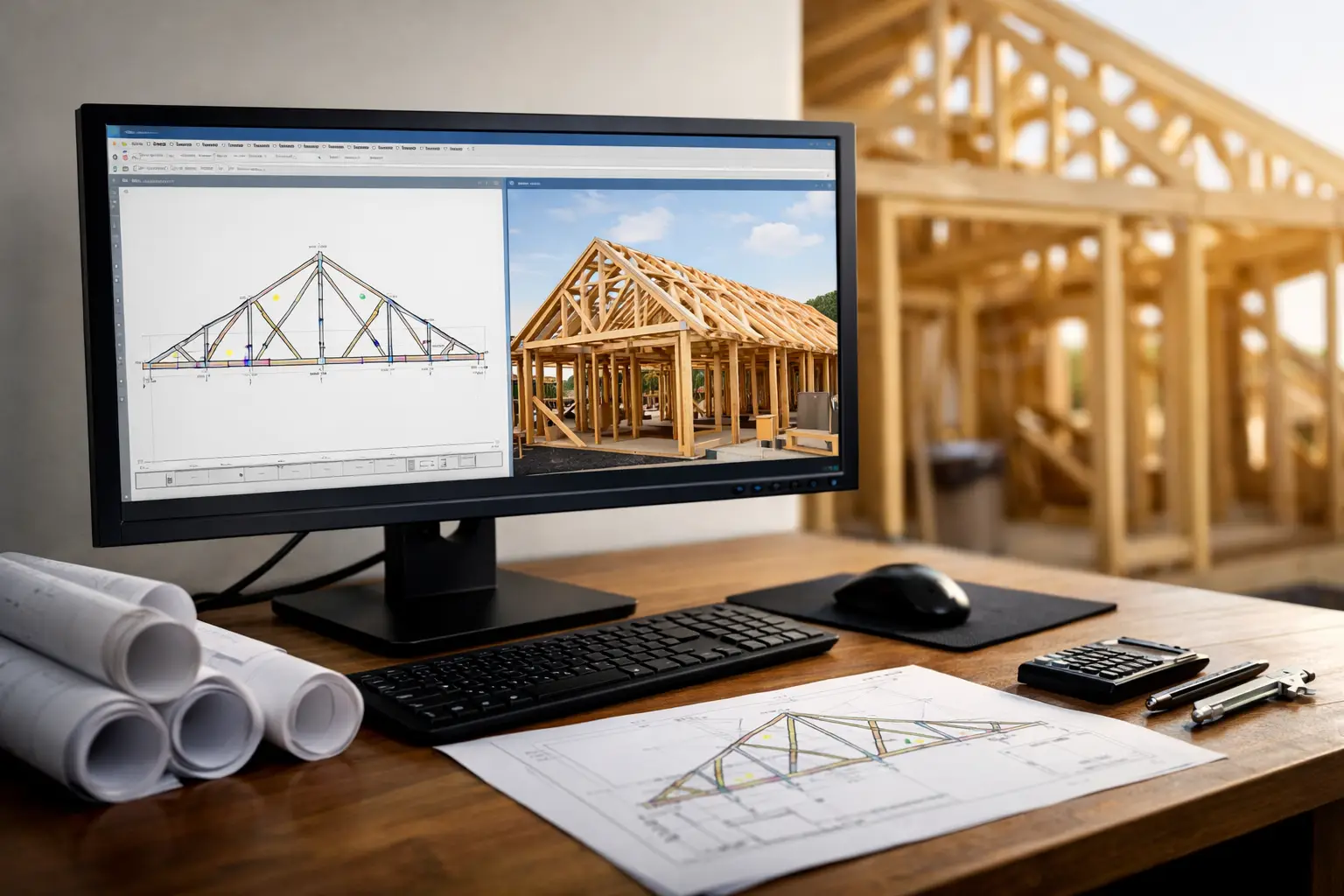
When a truss queue starts backing up, the problem usually is not software alone. It is throughput. You can have demand in hand, sales pressure building, and plant schedules tightening fast, but if your MiTek truss software designer capacity is limited, everything slows down at once – quoting, engineering handoff, production timing, and customer confidence.
That is why this topic matters to owners, design managers, and operations leaders. MiTek’s design environment is central to how many component businesses price work, produce layouts, and move jobs toward manufacturing. But the real business question is not whether the platform is capable. It is whether your team can use it at the speed and consistency your market requires.
Where MiTek truss software designer fits in the real workflow
In a working truss operation, software is not an isolated tool. It sits inside a chain that starts with incoming plans and ends with production-ready output. A designer has to interpret architectural intent, resolve framing conditions, apply loading assumptions, coordinate profiles, and produce clean, buildable designs. The software supports that process, but judgment still drives it.
That distinction matters. Many companies talk about software proficiency as if knowing the buttons is enough. It is not. A strong MiTek truss software designer understands how to move from incomplete plan sets to practical component solutions without creating downstream chaos for estimating, manufacturing, or field installation.
When that skill is present, the software becomes a force multiplier. Designers can process more jobs, recover faster from revisions, and maintain consistency across repeat customers. When that skill is missing, even good software turns into a bottleneck.
What separates an average designer from a high-output one
The gap usually shows up in speed, accuracy, and decision quality under pressure. Average designers can complete work when the plans are clean, the loads are straightforward, and the timeline is reasonable. High-output designers perform when the package is messy, the details conflict, and the sales team needs answers now.
A productive MiTek truss software designer does more than generate truss profiles. They know how to reduce unnecessary back-and-forth, flag structural conflicts early, and keep jobs moving with fewer avoidable revisions. They also understand the production side of the business. If a technically valid design creates manufacturing headaches or field confusion, it is not really a win.
This is where operational leaders should pay attention. The cost of a weak design function rarely appears in one line item. It shows up as delayed bids, overloaded checkers, rushed corrections, missed delivery windows, and margin erosion that compounds over time.
The software is powerful, but output still depends on people
MiTek’s design ecosystem is widely used for good reason. It helps standardize truss design workflows, supports engineered component production, and gives teams a structured way to move jobs from concept to fabrication. For many businesses, it is the backbone of component design operations.
Still, software does not eliminate staffing risk. If you cannot hire enough qualified designers, or if your experienced people are buried under volume, the platform alone will not protect your pipeline. This is where many truss plants and lumber dealers get stuck. They have the tools, the customers, and the opportunity, but not enough trained capacity to keep pace.
That is also why the hiring market for this skill set stays difficult. Good truss designers are not generic CAD users. They are specialized production professionals who understand structural logic, software execution, and job flow. Replacing that capability is rarely quick.
Why MiTek truss software designer capacity affects bid velocity
Most companies first feel the pain at estimating. A delayed design function slows quoting, and slow quoting costs real revenue. If your team needs accurate layouts, reactions, or material assumptions before they can confidently price a package, then design bandwidth directly affects bid velocity.
This is not just a sales issue. It is a growth issue. The companies that win more work are often the ones that can turn around more opportunities without sacrificing confidence in the numbers. If your design team is overloaded, you may start filtering which jobs you pursue, stretching lead times, or sending out less competitive bids because there is no time to optimize.
A capable MiTek truss software designer helps keep that from happening. They improve response time, support more parallel work, and create a more stable bridge between the front end of the business and the plant floor.
Common breakdowns in truss design operations
The biggest breakdowns are rarely dramatic. They are repetitive and expensive.
One is revision drag. Plans change, scope shifts, and customers adjust layouts after work is already underway. If your team does not have enough bandwidth, each revision disrupts the queue and pushes everything else back.
Another is inconsistent design quality across designers. Two people may both know the software, but one produces cleaner output with fewer callbacks and fewer checker interventions. Over time, those differences impact delivery speed and customer trust.
Then there is dependency risk. Many operations rely too heavily on a few senior people who carry the difficult jobs, train junior staff, and solve edge cases. That works until volume spikes, someone leaves, or the backlog gets too deep to recover quickly.
How to evaluate MiTek truss software designer support
If you are trying to strengthen capacity, look past résumés and software claims. The better question is whether a designer can perform inside your production reality.
That means understanding what kinds of projects they have handled, how they deal with incomplete information, how much checker support they require, and whether they can work within your standards. It also means looking at consistency. One strong week is not enough. You need repeatable output under real deadlines.
There is a strong case for trial-based validation here. Before scaling any design resource, test it on live or representative work. Measure speed, accuracy, communication quality, and revision handling. A true production partner should be confident enough to prove capability through execution, not just promises.
For companies scaling aggressively, flexibility matters too. Demand is not flat. Some months require steady baseline support. Others require surge capacity to keep bids moving or clear backlogs. A rigid hiring model struggles with that. A more elastic staffing approach gives operations leaders room to expand or contract without rebuilding the team every quarter.
What good implementation actually looks like
The best setup is not simply adding more designers. It is adding the right designers into a controlled workflow.
That starts with standards. File expectations, design assumptions, communication protocols, and review steps need to be clear. The faster your process moves, the more dangerous ambiguity becomes. Strong systems make outside or distributed design talent easier to integrate.
Next comes segmentation. Not every job needs your most senior internal people. If simpler or repeatable design work can be handled by qualified production support, your lead designers can stay focused on difficult projects, customer-facing coordination, and exception management.
Then there is continuity. Teams perform better when they are not starting from scratch on every assignment. Dedicated support models usually outperform random overflow help because they build familiarity with customer preferences, internal standards, and plant constraints. That is one reason specialized staffing models have become so effective in technical construction production.
For firms that need fast scale without long recruiting cycles, this is where an experienced partner can create immediate leverage. All Points Technical has built its model around exactly that pressure point – helping construction-related businesses add specialized production capacity in days, not months, with teams that already understand truss and component workflows.
The trade-off leaders should think through
There is no single right model for every business. Some companies should continue building in-house teams where local recruiting is working and demand is stable. Others need blended teams because volume is growing faster than hiring can keep up. And some need external production support because the market has already made traditional staffing too slow or too expensive.
The trade-off usually comes down to control, speed, and cost. Internal hiring can offer strong cultural alignment, but it often comes with longer timelines and higher fixed overhead. External technical staffing can increase speed and flexibility, but only if the provider understands your industry deeply enough to deliver real production value.
That last point is the key. General staffing is not the answer to specialized design bottlenecks. If the work depends on MiTek fluency, truss logic, and construction production discipline, your support model has to match that level of specialization.
Why this role stays mission-critical
The market does not reward businesses for having software licenses. It rewards businesses that turn demand into output. That is why the MiTek truss software designer role remains so critical. It sits at the point where opportunity becomes production, and where growth either accelerates or stalls.
If you are reviewing your operation, do not ask only whether your team has the right software. Ask whether you have enough proven design capacity to protect bid speed, maintain quality, and keep the plant fed when volume rises. That is the question that moves margins.
The companies that keep winning are usually not guessing here. They treat design capacity as a strategic asset, build around it early, and refuse to let staffing friction cap their growth.
Leave a Reply