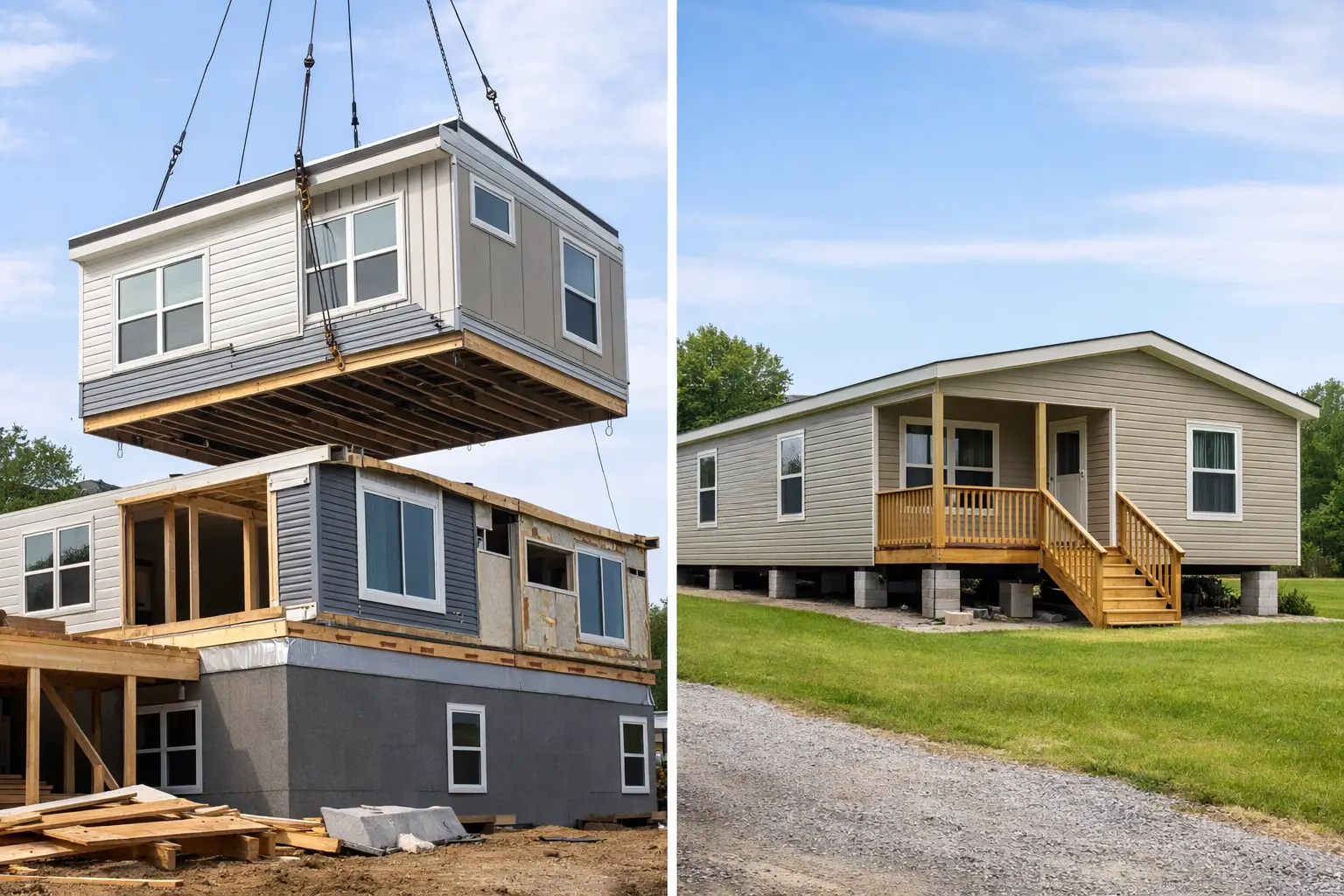
If you’re pricing factory-built housing for a project, a development, or a client, getting the difference between modular home and a HUD manufactured home wrong can throw off everything from permitting to scheduling to financing. These are not interchangeable labels. They follow different codes, move through different approval paths, and create different expectations for builders, lenders, inspectors, and buyers.
That matters in the field. A bad assumption here can stall installs, trigger redesigns, or create valuation problems late in the process. If you’re responsible for keeping projects moving and margins intact, you need a clean read on how these two housing types actually differ.
The difference between modular home and a HUD manufactured home starts with code
The biggest distinction is the code each home is built to.
A modular home is built in sections at a factory, then shipped to the site and assembled on a permanent foundation. Even though it is factory-built, it must comply with the same state, local, and regional building codes as a site-built home. That usually means the International Residential Code, plus any local amendments, wind requirements, snow loads, energy rules, and inspection standards that apply in that jurisdiction.
A HUD manufactured home is built to the federal HUD Code, not the local residential code. HUD is the U.S. Department of Housing and Urban Development, and its construction standard was created specifically for manufactured housing. These homes are also factory-built, but the governing code is national and separate from the code used for modular or site-built houses.
That one difference drives almost everything else. It affects design criteria, inspection workflow, transport rules, installation details, and in many cases how the home is treated by lenders and local zoning officials.
Why the labels matter on real projects
People often use “mobile home,” “manufactured home,” and “modular home” as if they mean the same thing. They don’t.
A manufactured home built after June 15, 1976 falls under the HUD Code. Older units are often referred to as mobile homes because they predate that federal standard. A modular home is not a mobile home and not a HUD-code home. It is a code-compliant dwelling built off-site in modules.
For builders and developers, this is more than semantics. If the wrong housing type is assumed during budgeting or preconstruction, the team may run into foundation changes, transportation issues, or approval delays. For estimating and planning teams, precision upfront saves expensive cleanup later.
How inspections work
Modular homes are generally inspected under state-approved modular programs and then finalized with local site inspections once set on the foundation. Local building departments usually stay involved because the finished home must satisfy the same occupancy standards as a conventional house.
HUD manufactured homes follow a different path. They are inspected in production under the federal program, and each section carries a HUD certification label. Site work and installation still require compliance with state and local requirements, but the home itself is not being approved under the same local residential code used for modular construction.
That split can shape project timing. If your team is coordinating field labor, foundations, utility connections, and crane scheduling, knowing which inspection path applies helps prevent dead time.
Structural and design differences
Both home types are built in factories, but they are engineered for different delivery and regulatory demands.
A modular home is designed to become a permanent structure that aligns with local building standards once assembled. The modules are transported to the site, but after installation the finished product is treated much more like a traditional house. The frame, roof loads, wall systems, and foundation integration are typically designed around permanent placement.
A HUD manufactured home is built on a permanent chassis. That chassis is part of the transport system and remains with the home. The home may be installed on permanent or non-permanent foundations, depending on the setup, financing, and local requirements.
This affects design flexibility too. Modular homes often offer more freedom in roof pitch, layout complexity, attached garages, and site-specific customization because they are built to fit local code expectations. Manufactured homes can absolutely be high quality and attractive, but they work within a more standardized federal framework.
That does not mean one is automatically better. It means each product is optimized for a different combination of cost, speed, compliance, and placement.
Foundation, transport, and installation are not the same
This is where operations teams need to pay attention.
A modular home is shipped in volumetric sections and set by crane on a permanent foundation. Once connected, finished, and inspected, it functions like a site-built home in most practical and legal respects.
A HUD manufactured home arrives on its chassis and is installed according to manufactured housing installation standards. Depending on the project, that may involve piers, tie-down systems, perimeter supports, or engineered foundation systems approved for manufactured housing.
Transport logistics differ too. Module dimensions, route restrictions, escorts, set-day crane access, and site staging can vary significantly between the two. If you’re involved in planning or outsourcing technical support for housing-related production work, these differences affect detailing, permitting packages, and schedule coordination.
Financing, appraisal, and resale can look very different
The difference between modular home and a HUD manufactured home often becomes most visible when lenders and appraisers get involved.
Modular homes are commonly financed more like site-built homes, especially when placed on a permanent foundation and titled as real property. Appraisers typically compare them to other site-built or modular homes in the area, assuming local market data supports that approach.
HUD manufactured homes can be financed as real property in some cases, especially when permanently installed on owned land and converted appropriately under state rules. In other cases, they may be financed more like personal property, sometimes called chattel lending. Loan terms, down payments, interest rates, and appraisal methods may differ.
That has direct consequences for affordability and long-term value. A modular home often has an easier path to conventional mortgage treatment. A manufactured home may offer a lower initial price point, but financing terms can vary more depending on land ownership, foundation type, age of the home, and state requirements.
Resale follows similar logic. Market perception, comparable sales, location, and condition all matter, but modular homes are more often grouped with conventional housing. Manufactured homes are usually evaluated within the manufactured housing market unless the property setup supports broader treatment.
Zoning and land use can decide the deal
One of the most overlooked issues is whether the home is even allowed on the target site.
Many jurisdictions treat modular homes similarly to site-built homes because they comply with local residential code. If the design meets setbacks, appearance standards, and lot requirements, approval is usually more straightforward.
HUD manufactured homes may face additional zoning restrictions, park requirements, design standards, or placement limitations. Some areas welcome them. Others restrict them heavily or require special approvals. For developers, builders, and operations teams, this is where early due diligence pays off.
Never assume a parcel that accepts a modular home will also accept a manufactured home. That mistake can burn time fast.
Which one makes more sense?
It depends on the business case.
If the priority is lower upfront cost and faster access to standardized housing, a HUD manufactured home may be the right fit. It can be a strong option for rural placements, workforce housing, replacement housing, and buyers focused on budget discipline.
If the priority is alignment with local code, conventional financing, broader zoning acceptance, and a product that behaves more like site-built housing in the market, modular often has the edge.
For construction businesses, the decision usually comes down to total project friction, not just unit cost. Code path, site readiness, engineering requirements, financing structure, approval risk, and install complexity all carry cost. Smart operators do not price the box alone. They price the whole delivery system.
That is the kind of thinking high-output teams rely on every day. Companies like All Points Technical help construction businesses scale technical production by getting these details right before they become field problems – because accurate decisions upstream protect schedule and margin downstream.
The bottom line on modular vs. HUD manufactured
A modular home is built off-site to the same local or state building code as a site-built house and is assembled on a permanent foundation. A HUD manufactured home is built off-site to the federal HUD Code and transported on a permanent chassis under a different regulatory framework.
Both can solve real housing needs. Both can be cost-effective. Both can be built with quality. But they are not the same product, and treating them like they are is where bad estimates, bad assumptions, and bad outcomes begin.
If you’re evaluating factory-built housing, ask the first hard question early: which code governs the home? Once that answer is clear, the rest of the project gets a lot easier to control.
Leave a Reply