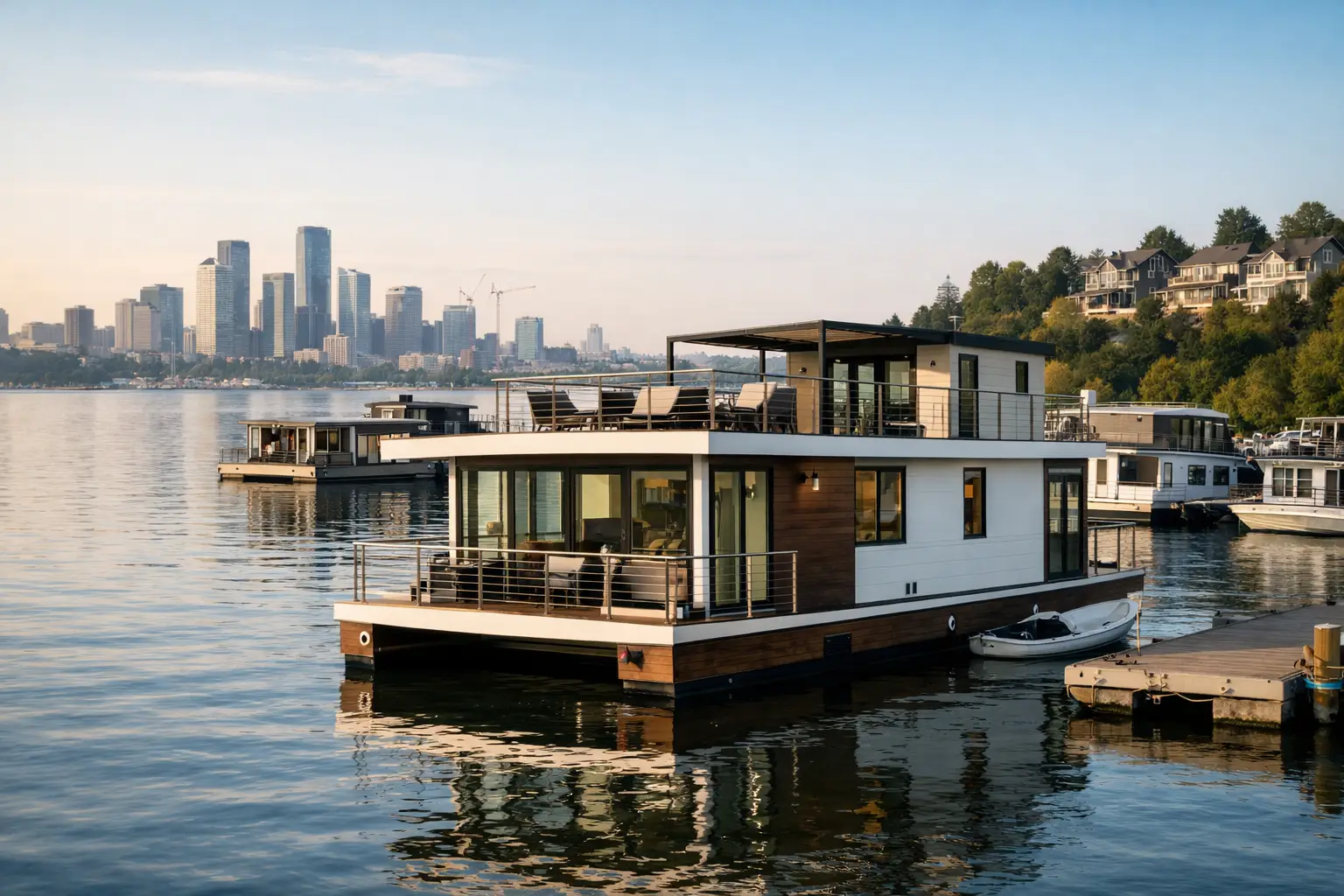
A buildable lot can now cost more than the structure planned for it in many waterfront and high-growth markets. That pressure raises a legitimate question: will houseboat production gain share as land prices rise? The short answer is yes, in selected markets and buyer segments. But floating housing will not become a broad substitute for land-based construction until marinas, codes, lending, insurance, and production capacity move in the same direction.
For construction operators, component manufacturers, designers, and specialty builders, this is not a novelty-market question. It is a capacity question. Where conventional housing is constrained by scarce land, extended entitlement timelines, and escalating site costs, factory-built floating structures can offer a faster route to usable square footage. The opportunity is real. So are the constraints.
Why High Land Prices Create an Opening for Houseboats
High land prices do more than make a finished home expensive. They increase the capital tied up before a builder has poured a foundation, framed a wall, or generated revenue. In land-constrained waterfront areas, the cost of acquisition, grading, utility extensions, permitting, and carrying the parcel can make smaller residential projects difficult to pencil out.
A houseboat or floating home changes part of that equation. The buyer may pay for a marina slip, docking rights, or a leasehold arrangement rather than purchasing waterfront land outright. The structure can also be built in a controlled production environment, then delivered to its final berth. That model reduces exposure to weather delays, difficult site access, and some of the sequencing problems that undermine field productivity.
The distinction between a houseboat and a floating home matters. A houseboat is often classified and regulated as a vessel, while a floating home is generally intended to remain connected to a berth and may be subject to building codes, marina rules, and local residential regulations. The market potential, financing path, design requirements, and production methods differ significantly between the two.
That distinction is why demand cannot be measured by land prices alone. A buyer may see a floating residence as an attainable waterfront lifestyle purchase, a compact primary residence, a hospitality asset, or an alternative to a costly vacation property. Each use case carries different approval, utility, occupancy, and operating requirements.
Will Houseboat Production Gain Share? The Case for Growth
Houseboat production is positioned to gain share where five conditions converge: expensive waterfront land, limited housing supply, established marina infrastructure, permissive local regulation, and buyers willing to accept nontraditional ownership or financing structures.
The strongest demand is unlikely to come from every market with high home prices. It will emerge in places where people already value water access and where docks, utility hookups, wastewater systems, emergency access, and managed slips exist or can be expanded. A floating home cannot solve a land shortage if there is no legal place to moor it.
Production economics also support measured growth. Modular and panelized fabrication can compress build schedules, improve repeatability, and reduce waste compared with fully site-built waterfront homes. Standardizing hull or flotation systems, floor plans, wall panels, mechanical chases, and interior packages allows producers to protect margin while offering buyers a more predictable delivery timeline.
The best operators will not treat every unit as a custom yacht. They will create product platforms. A repeatable 600- to 1,200-square-foot floating-home platform can be adapted through finishes, deck packages, bedroom layouts, and energy options without reinventing structural and mechanical systems every time. That is where production scale begins.
For builders and manufacturers, the commercial appeal is straightforward: less site labor, more controlled work, fewer weather interruptions, and a product that can reach buyers priced out of traditional waterfront ownership. For marina owners, professionally designed floating residences can create recurring berth revenue and activate underused waterfront capacity.
The Constraints That Keep This From Becoming a Mass-Market Shift
Land prices may trigger demand, but they do not remove the hard limits of the waterfront.
Marina Capacity Is the First Bottleneck
The most obvious constraint is berth availability. A floating home needs more than water depth. It needs a marina or dock system engineered for the unit’s weight, utility demand, fire access, mooring loads, and local environmental requirements. Many marinas were designed for recreational boats, not year-round residences with larger electrical loads, permanent water connections, and regular waste service.
Expanding marina capacity can be as politically difficult as building housing on land. Waterfront jurisdictions may restrict liveaboards, limit occupancy, control dock expansion, or require extensive environmental review. A manufacturer can increase plant output quickly. It cannot manufacture legal moorage.
Codes, Classification, and Permitting Add Complexity
Traditional residential construction follows familiar code pathways. Floating structures often sit at the intersection of building codes, marine standards, local zoning, Coast Guard considerations, marina operating rules, and insurance requirements. Jurisdictional ambiguity can slow a project long before fabrication begins.
That increases the value of disciplined engineering and documentation. Producers need clear structural load paths, buoyancy and stability calculations, corrosion-resistant material specifications, mechanical and electrical designs suited to marine conditions, and coordinated permit sets. A design package that works in one jurisdiction may not be accepted in another.
Financing and Insurance Still Lag the Product
A buyer can usually find conventional mortgage products for a land-based home. Floating homes may require marine financing, portfolio lending, cash purchases, or specialized loan structures. Interest rates, down payments, terms, and appraisal practices can be less favorable.
Insurance is equally variable. Exposure to storms, flooding, fire, wake damage, and marine liability can raise premiums or reduce available coverage. A lower entry price does not automatically mean lower monthly ownership costs. Builders and sellers who ignore this reality will lose credibility with buyers.
Not Every Buyer Wants the Trade-Offs
Living on the water delivers access and lifestyle. It also brings movement, maintenance, humidity, limited storage, dock security concerns, and reliance on marina operations. Families may need parking, school access, larger floor plans, and long-term stability that a floating residence cannot always provide.
That makes houseboats a targeted housing category, not a replacement for subdivisions, multifamily developments, or conventional infill. The winning market is likely to be buyers who prioritize location and experience over lot size and traditional real estate ownership.
Production Will Depend on Construction Discipline, Not Hype
The manufacturers that gain share will operate more like advanced building-product companies than custom boat shops. They will standardize engineering, maintain controlled bills of materials, design for transport and installation, and build repeatable quality-control gates into every production stage.
This requires cross-disciplinary production talent. A floating unit needs architectural planning, structural detailing, electrical and plumbing coordination, HVAC design, material estimating, fabrication drawings, and often marine-specific engineering. When those functions are fragmented, rework compounds quickly. A late change to flotation, a utility chase, or roof loading can affect the entire assembly.
Digital production workflows can reduce that risk. CAD, Revit, BIM coordination, structural detailing, and accurate estimating allow teams to identify clashes before fabrication, control material usage, and generate cleaner installation packages for dock and utility crews. This is especially important as producers move from one-off builds to multiple units per month.
The labor issue is just as critical. Manufacturers cannot scale if every project depends on finding local specialists in estimating, drafting, structural coordination, and production detailing. Dedicated technical teams can expand bid capacity and keep design packages moving while domestic leadership focuses on approvals, customer decisions, fabrication, and installation.
All Points Technical supports this kind of production model by giving construction businesses access to specialized design, estimating, CAD, Revit, BIM, and structural detailing capacity without waiting through a traditional hiring cycle. For an emerging segment such as floating housing, that flexibility can be the difference between testing a product line and building a scalable operation.
Where the Real Opportunity Sits
The near-term opportunity is not simply “more houseboats.” It is professionally engineered, code-aware floating housing delivered into markets with a realistic berth strategy. Producers should assess demand alongside marina agreements, regulatory pathways, utility capacity, insurance options, and service requirements before committing capital to a new line.
There is also a strong case for adjacent applications. Boutique hospitality, workforce lodging near coastal job centers, short-term rental concepts where permitted, and premium second homes may create earlier demand than primary-residence communities. These uses can support higher unit economics while the residential financing and regulatory environment matures.
High land prices will continue to push buyers, developers, and municipalities to consider alternatives that use space differently. Houseboat production can claim a larger share of that conversation, but only where the full delivery system is in place. The builders that win will not sell a dream of living on water. They will engineer a dependable product, secure a legal place for it to live, and deliver it with the same production discipline expected from any serious construction operation.
Leave a Reply