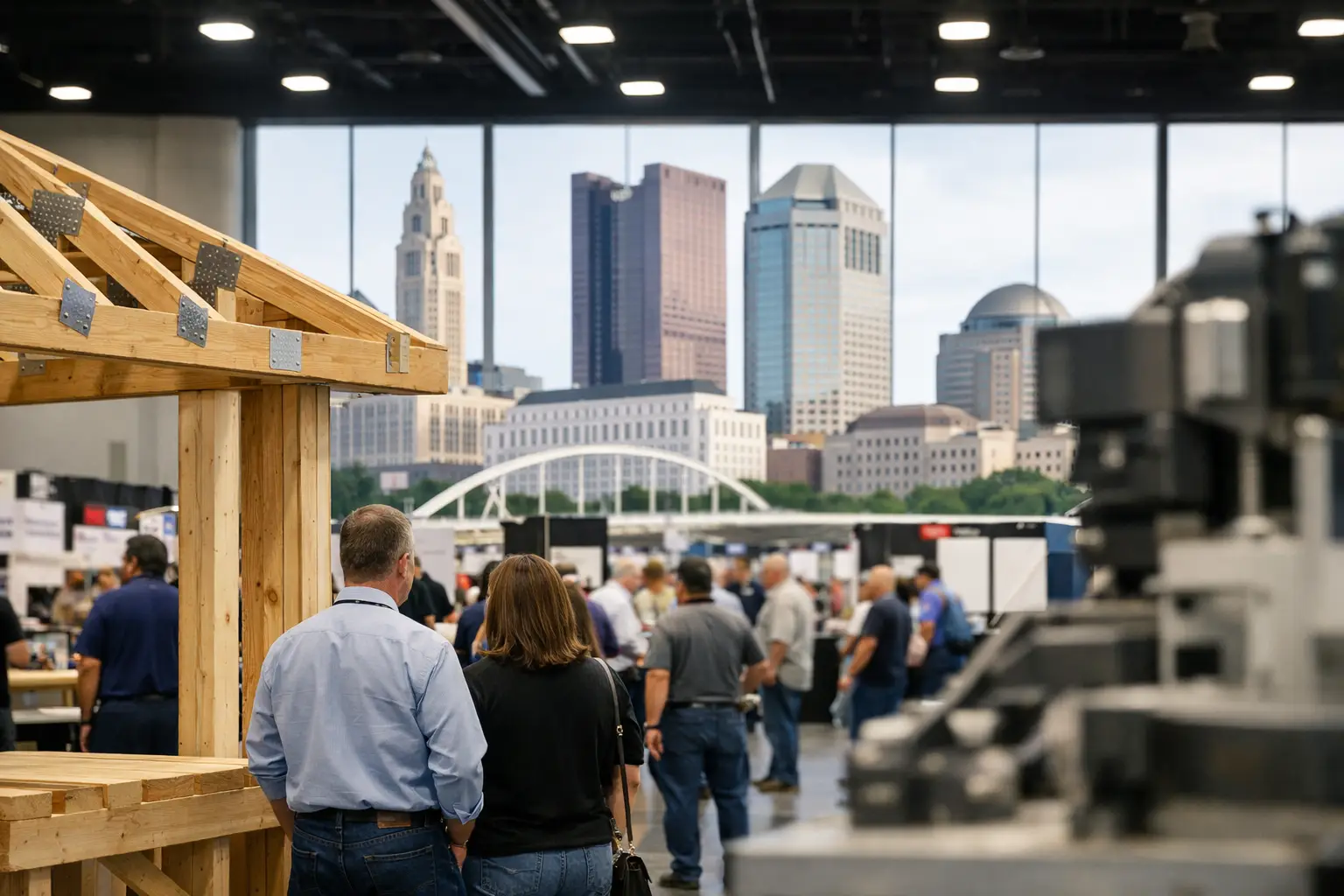
If you’re attending this year’s BCMC trade show in Columbus, Ohio, don’t show up looking for swag and small talk. Show up looking for throughput, labor solutions, software leverage, and better ways to protect margin. BCMC is one of the few events where plant operations, component manufacturing, software, machinery, engineering, and field reality all collide in one place. That makes it valuable – but only if you work the show with a plan.
For owners, design managers, estimators, and operations leaders, BCMC is not a casual industry outing. It’s a pressure test. You get a live look at where the component industry is moving, which vendors are solving real production problems, and which conversations are worth taking back to your team on Monday.
Why attending this year’s BCMC trade show in Columbus, Ohio matters
The companies that get the most out of BCMC usually walk in with a business problem, not a general sense of curiosity. They want to increase design capacity. They need to reduce estimating backlog. They’re trying to improve manufacturing speed without adding avoidable overhead. Or they’re staring at the same issue hitting the entire industry – not enough skilled technical labor to support growth.
That’s where BCMC earns its time commitment. You can compare machinery, software, automation workflows, connectors, and production systems in one concentrated environment. More importantly, you can have direct conversations with people who understand the actual bottlenecks inside truss plants, component shops, lumber operations, and structural production teams.
There’s also real value in seeing how the market is talking about labor. Some suppliers will pitch efficiency through equipment. Others will pitch software integration. A smaller number will speak directly to production support, design bandwidth, and technical staffing. All of those matter, but they solve different problems. A machine may increase output on the floor. It does not automatically solve design queue delays, estimating overflow, or the inability to turn more bids fast enough.
Go in with operating questions, not generic curiosity
A productive BCMC schedule starts before you land in Columbus. The smartest attendees define what they need to learn in operational terms.
If your sales team is winning opportunities but engineering is slowing intake, that is a capacity issue. If your estimators are stretched and quotes are going out late, that is a bid-speed problem. If your plant can build more than your technical team can release, that is a production pipeline problem. BCMC helps when you know which one you’re trying to fix.
That changes the conversations you have on the floor. Instead of asking, “What does your company do?” ask, “How fast can this improve turnaround time?” Ask what implementation actually looks like. Ask how much internal training is required. Ask whether the solution reduces dependence on hard-to-hire domestic roles or simply shifts the burden from one department to another.
That last point matters. Plenty of good ideas die in implementation because they require more internal bandwidth than the business can spare. A solution that looks strong in a demo can become expensive if it takes months to onboard, retrain staff, and rebuild workflow.
What to pay attention to on the show floor
The show floor can pull you in ten directions at once. Stay focused on four categories that usually have the biggest operational impact: equipment, software, process integration, and labor strategy.
Equipment is the most visible category, and for good reason. Plant automation, saw systems, material handling, and production hardware can create serious gains when the volume justifies the investment. But hardware only pays off when the upstream work is ready. If design releases are inconsistent or estimates are lagging, the equipment sits downstream from the real bottleneck.
Software deserves closer scrutiny than it often gets. Not every software improvement creates measurable output gains. Some tools improve visibility but don’t materially change speed. Others help standardize production, reduce errors, or increase coordination between design and manufacturing. The difference usually comes down to adoption. Ask whether teams like yours are fully using the platform or only buying into part of its promise.
Process integration is where a lot of hidden value sits. Watch for companies that understand handoff points between estimating, design, engineering review, manufacturing, and delivery. In most construction-related businesses, delays happen at transitions, not just inside tasks. A vendor or service partner that speaks clearly about workflow continuity is usually worth more attention than one selling a standalone feature.
Then there’s labor strategy, which may be the most important category of all. If you can’t hire enough truss designers, estimators, CAD technicians, BIM detailers, or structural production support, growth stalls no matter how good the rest of the system looks. This is the conversation many companies still approach too late. They wait until backlog becomes painful, then start hiring into a market that’s already tight.
The real value of face-to-face meetings at BCMC
BCMC is one of the best places to speed up decision-making because weak answers become obvious in person. You can hear whether someone understands your business or is reciting a script. You can test how they talk about implementation, quality control, staffing depth, and turnaround expectations. You can also get a better read on whether they’ve actually worked with operations leaders dealing with production pressure.
That matters if you’re evaluating service partners, not just products. A technical production partner should be able to discuss output, QA structure, software familiarity, ramp-up speed, and communication rhythm without hesitation. If they can’t explain how they keep work moving across time zones, support review cycles, or scale with pipeline changes, the model may not hold under pressure.
For businesses dealing with chronic labor shortages, this is where in-person conversations can save months. You can move past vague claims and get straight to fit: what roles can be supported, how trial work is handled, how quality is validated, and how quickly a team can become productive. The strongest partners will talk in terms of throughput and business continuity, not just resumes.
How to judge whether a solution is actually worth bringing home
The best BCMC conversations lead to a very simple question: will this help us produce more, faster, and with better control?
If the answer is yes, the next issue is timing. Some investments are right for companies with stable volume and capital ready to deploy. Others make more sense when you need flexibility first. That’s the trade-off many businesses are navigating right now. They want to grow, but they do not want to lock themselves into fixed overhead before the pipeline proves out.
That’s why scalable production support is getting more attention. Instead of waiting months to recruit local technical staff, some firms are building dedicated offshore and hybrid teams that can increase bid capacity, design output, and drafting support without the same hiring friction. For the right operation, that changes the math. It can create breathing room fast, especially when domestic recruiting has already slowed growth.
That approach is not one-size-fits-all. If your workflow is undocumented, your review standards are inconsistent, or your leadership team is not ready to manage capacity intentionally, even a good staffing model can underperform. But if you know your process and need more trained hands in specialized roles, it can be one of the fastest ways to get up and running in days, not months.
Make attending this year’s BCMC trade show in Columbus, Ohio actionable
Too many attendees leave with brochures, vague follow-ups, and no internal next step. That’s wasted opportunity. Before the event ends, decide what category each promising conversation falls into: immediate action, near-term evaluation, or future watch list.
Immediate action means the problem is active now and the solution deserves a serious post-show meeting. Near-term evaluation means the fit looks strong, but you need more internal data, budget clarity, or stakeholder input. Future watch list means the idea is interesting, but not tied to current operating priorities.
This discipline matters because trade shows create momentum that disappears fast once everyone returns to backlog, customer calls, and production issues. The companies that get ROI from BCMC convert conversations into decisions while the details are still fresh.
For leaders in truss, components, estimating, detailing, and structural production, this is the larger point: BCMC is not just where you see what’s new. It’s where you decide what kind of business you want to run next year. More dependent on a thin labor market, or built with enough capacity and flexibility to keep taking work when competitors can’t.
If you walk the floor with that lens, Columbus becomes more than a calendar event. It becomes a chance to make your operation faster, harder to disrupt, and better positioned for growth.
Leave a Reply