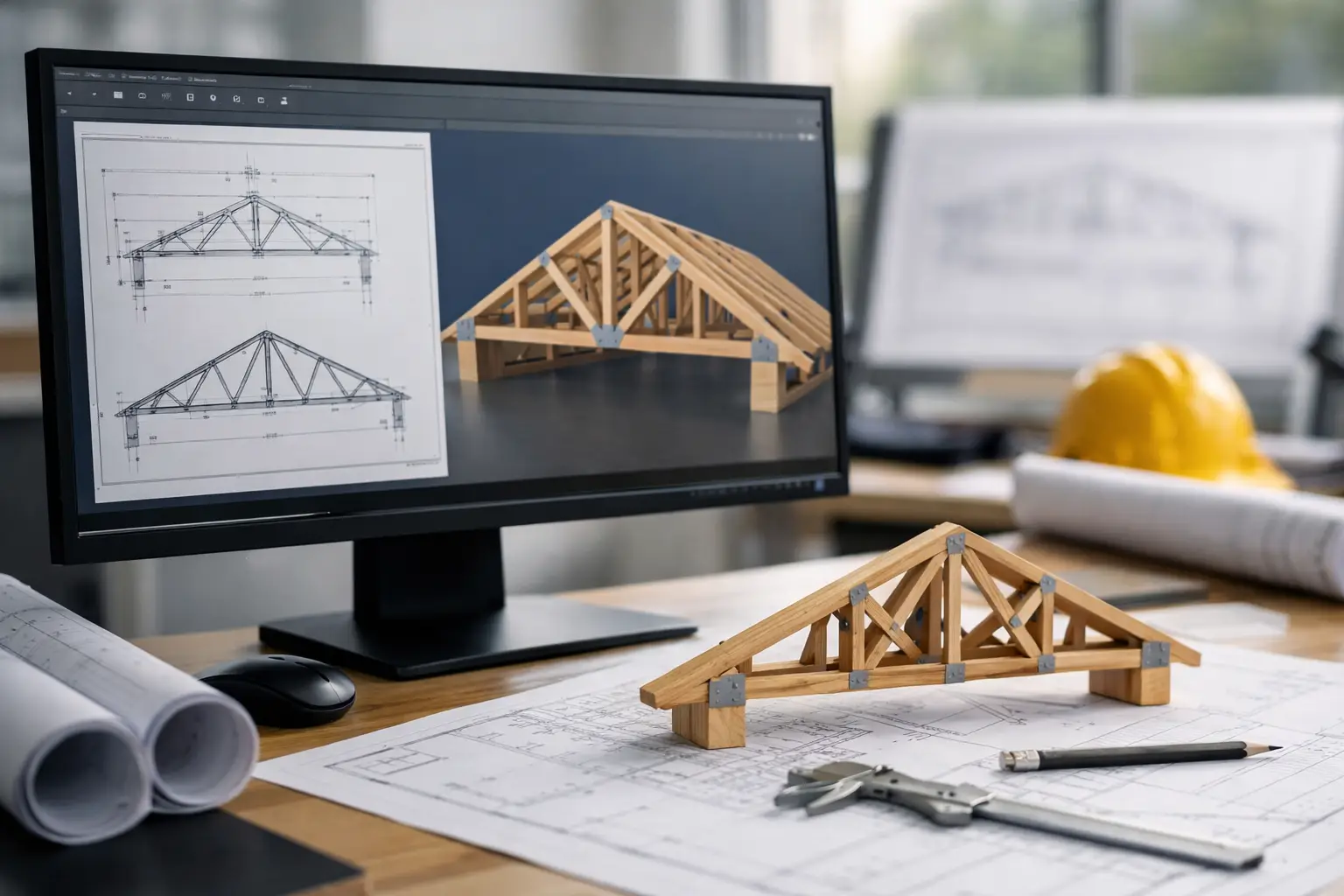
If you’re asking what truss design software is the best, you’re probably not looking for a generic top-10 list. You’re trying to protect throughput, keep engineering clean, reduce redraws, and get more work out the door without creating chaos on the plant floor. That changes the answer fast.
The best truss design software is not simply the platform with the longest feature sheet. It’s the one that fits your production model, your engineering requirements, your customer mix, and the skill level of the people actually using it every day. For one operation, that means deep integration with a plate supplier’s ecosystem. For another, it means speed in layout, easy revision control, and the ability to onboard designers quickly.
This is where a lot of buyers get stuck. They compare software like they’re buying a general office tool. Truss design software is different. It sits in the middle of sales, estimating, design, manufacturing, and field performance. A weak fit doesn’t just slow down one department. It drags on bids, labor, quality, and margin.
What truss design software is the best for your operation?
The honest answer is that there is no universal winner. There are dominant platforms in the market, and some are clearly stronger than others in specific environments, but “best” depends on how your business makes money.
If you’re a high-volume truss manufacturer tied closely to a certain connector plate supplier, software alignment with that supplier’s systems often matters more than abstract feature comparisons. If you’re serving a wider mix of custom residential, multifamily, and light commercial work, flexibility in modeling, loading, and output can matter more. If you’re growing fast and struggling to hire experienced designers, usability and training curve become major decision factors.
So instead of asking which platform wins in theory, ask which one helps your team move faster with fewer errors and less dependency on hard-to-find local talent.
The leading truss design software platforms
In the US market, the conversation usually centers on a handful of established systems. MiTek software still remains a major force because of its market penetration, engineering workflows, and broad use across truss plants. Alpine software is also deeply embedded in many operations, especially where plant processes and supplier relationships are already built around that environment. Combined with the #1 hanger provider; Simpson Strong-Tie’s component software enters the conversation in certain manufacturing setups as well, depending on the product mix and structural workflow. And certainly dont overlook Eagle and Paragon as great options. All Points Technical can provide design teams with all available software’s. In Australia and NZ markets, certainly look at Multinail.
Some teams also evaluate broader structural or BIM-adjacent tools, but those usually do not replace dedicated truss design software in a production environment. They may support coordination, review, or downstream detailing, but they are not the same thing as a platform built specifically for truss layouts, loading, engineering checks, manufacturing output, and plant-ready documentation.
That distinction matters. A program can look impressive in a demo and still be the wrong tool if it adds friction between design and fabrication.
What separates a strong platform from an expensive headache
The first separator is engineering confidence. Truss software has to do more than draw cleanly. It needs to handle loading conditions, member design, plate selection logic, and output in a way your engineers and production teams trust. If your staff spends half their day second-guessing the software, the platform is not helping.
The second separator is production speed. Some systems are powerful but slower to work in, especially for less experienced designers. Others support faster repetition on common jobs but may become clunky on complex layouts. This is where your actual job mix matters more than vendor claims.
The third is talent availability. This is a bigger issue than many owners realize. A platform may be excellent, but if experienced designers are hard to find in that environment, your labor strategy takes a hit. Software decisions and staffing decisions are connected. The best software for your business is partly the one you can actually build a scalable team around.
The fourth is integration. If the software connects cleanly with estimating, material optimization, shop documentation, saw output, or ERP workflows, that can save serious time. If it creates workarounds, spreadsheets, and re-entry points, the hidden cost builds quickly.
MiTek vs Alpine and the real-world trade-off
For many buyers, the real question is not what truss design software is the best in the abstract. It’s whether MiTek or Alpine is the better fit.
MiTek often gets strong marks for broad market adoption, established workflows, and the size of the available user base. That matters because it affects hiring, training resources, and the availability of experienced production talent. If you need to scale design capacity quickly, widespread software adoption can become a real operational advantage.
Alpine can be the right fit in plants that are already optimized around its ecosystem and support structure. In those settings, changing platforms may create more disruption than value. Even if another system looks better on paper, retraining, process redesign, and compatibility issues can wipe out the benefit for months.
This is the part many articles skip. Switching software is not just a technology decision. It is a production decision, a staffing decision, and often a customer service decision. If the transition slows submittals or introduces avoidable design inconsistencies, your sales pipeline feels it.
The questions smart operators ask before choosing
Start with output. What types of projects drive your margin? High-volume single-family work, custom residential, multifamily, agricultural, floor systems, roof packages, or light commercial each put different pressure on the software.
Then look at workflow friction. Where do jobs currently stall? In engineering review, in estimating handoff, in revisions, in shop package generation, or in plant communication? The right software should attack bottlenecks, not just add features.
Training is next. How long does it take a new designer to become productive? Not certified. Productive. Those are not the same thing. If your growth plan depends on building bench strength, software with a steep learning curve may cost more than the license itself.
Finally, look at support and scale. Can the platform support a distributed team? Can outside designers work in it efficiently? Can you add capacity without rebuilding your process every quarter? These are not side issues. They directly affect bid velocity and labor cost.
Why software alone will not solve your bottleneck
A lot of companies overestimate what software can fix. Good software improves speed and consistency, but it does not create experienced truss designers out of thin air. If your biggest problem is talent shortage, the software decision only solves half the problem.
This is why some of the highest-performing truss operations stop treating software as a standalone purchase. They treat it as part of a production system that includes staffing, training, QA, standardization, and time-zone coverage. That is where the real advantage shows up.
A strong platform in the hands of an understaffed team still creates backlog. A solid platform paired with trained design capacity can increase bids, protect turnaround time, and keep plants fed without forcing you into desperate local hiring cycles.
For companies scaling aggressively, this is often the better question: not just “What truss design software is the best?” but “What software and delivery model will let us produce more without breaking operations?” That is where companies like All Points Technical have pushed the market forward by pairing software-proficient truss design talent with production-driven workflows.
The best choice depends on the cost of being wrong
If you choose a platform that doesn’t fit, you usually don’t feel it on day one. You feel it six months later in delayed approvals, uneven design quality, overtime, frustrated estimators, and production teams working around documentation issues. The software may still be technically capable, but the business pays for the mismatch.
That is why the best software is the one that performs under your real conditions. Not ideal conditions. Real ones. Your customer deadlines. Your team mix. Your revision load. Your engineering standards. Your hiring constraints.
For one company, that will be MiTek. For another, Alpine or Simpson. For a few, the answer depends on a broader component design ecosystem already in place. There is no serious operator advantage in pretending otherwise.
What matters is choosing the platform that helps your team execute faster, train smarter, and scale with fewer failure points. Software should increase production confidence, not add another layer of management.
If you’re evaluating truss design software right now, don’t chase the loudest brand claim. Look at plant fit, talent fit, and workflow fit. The best platform is the one that makes your operation harder to beat next quarter, not just easier to demo this week. www.allpointstech.ai
Leave a Reply